
#Ep.059
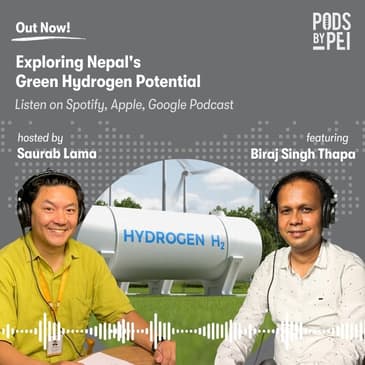
Nepal's energy discourse has largely been centered around its immense hydropower potential. However, experts are now talking about Nepal's potential for green hydrogen and its role in the country's commitment to sustainable energy. With International collaborations, such as the partnership between the Green Hydrogen Lab, Kathmandu University, Nepal Team Hydrogen, and NTNU, Norway, a significant interest in advancing green hydrogen research and development in Nepal is growing.
In this episode, guest host Saurab Lama sits with Biraj Thapa to uncover the complexities and promises of Nepal's journey towards a sustainable energy future through green hydrogen. They navigate the recent collaborations among key institutions and explore the historical evolution of this green energy. They also discuss the global hydrogen landscape, its applications beyond mobility, challenges, and recent developments in Nepal.
Biraj Singh Thapa is an Assistant Professor at the Department of Mechanical Engineering at Kathmandu University and is also the team leader of the Green Hydrogen Lab there. His area of specialization is hydropower and green hydrogen. At present, he is focusing on the energy ecosystem for the transition towards a low-carbon society in the Himalayan region. He is leading several projects to implement hydropower as the means for introducing green hydrogen as an alternative future fuel in Nepal. He holds a Ph.D. degree from NTNU, Norway.
If you liked the episode, hear more from us through our free newsletter services, PEI Substack: Of Policies and Politics, and click here to support us on Patreon!!
[00:00:13] - [Speaker 0]
Namaste and welcome to Pods by PEI, a policy discussion series brought to you by Policy Entrepreneurs Inc. My name is Kushi Hang and in today's episode, guest host Saurabh Lama sits with Biraj Thapa for a conversation on exploring Nepal's green hydrogen potential. Biraj Singh Thapa is an assistant professor at the Department of Mechanical Engineering at Kathmandu University and is also the team leader of the green hydrogen lab there. His area of specialization is hydropower and green hydrogen. At present, he is focusing on the energy ecosystem for the transition towards a low carbon society in the Himalayan region.
[00:00:50] - [Speaker 0]
He is leading several projects to implement hydro power as the means for introducing green hydrogen as an alternative future fuel in Nepal. He holds a PhD from NTNU Norway. In this episode, Saurabh and Biraj uncover the complexities and promises of Nepal's journey towards a sustainable energy future through green hydrogen. They navigate the recent collaborations among key institutions and also explore the historical evolution of this green energy. They then discuss the global hydrogen landscape, its applications beyond mobility, challenges, and recent developments in Nepal.
[00:01:26] - [Speaker 0]
We hope you enjoy the conversation.
[00:01:33] - [Speaker 1]
So welcome back, dear listeners, to another exciting episode of our podcast series Pods by PI. Today, we have a special guest joining us who has been at the forefront of green hydrogen research and development in Nepal. Let me welcome Biraj Singh Thapa onto today's show. Biraj, welcome to Pods by PI. How are you doing today?
[00:01:52] - [Speaker 2]
Fantastic. It's wonderful. Thank you so much for inviting me here.
[00:01:55] - [Speaker 1]
And it is our pleasure to have you here on today's episode. Shall we get on with our topic of conversation then?
[00:02:02] - [Speaker 2]
Yes, please.
[00:02:03] - [Speaker 1]
So before we dive into our conversation, let me first congratulate you and the green hydrogen lab at Kathmandu University Nepal for their recent letter of understanding with Team Hydrogen at NTNU Norway that no doubt opens up new avenues for academic and research activities on hydrogen for energy transition and green growth. So let's bring our listeners up to speed on the significance of this collaboration. To start, what does the exchanging of these letters of understanding mean for Nepal? What exciting opportunities and possibilities lie ahead?
[00:02:41] - [Speaker 2]
I belong to university, and the main work of university is to create knowledge. And to create knowledge, we we need to do core research. And Norway is one of the forefront university in Europe. They are leading the research on energy transitions. They are leading research on future fuel, and they are leading research on hydrogen.
[00:03:03] - [Speaker 2]
To bring the knowledge, to develop the human resources and the capacity in Nepal, we need to collaborate who are leading the ways. And this letter of exchange is the door for Nepal and Katmai University to step into the energy transition, to step into the carbon neutrality of our country, and to bring the new knowledge for the development of our country with the hydrogen and the energy that we have hydropower.
[00:03:29] - [Speaker 1]
So now let's take a journey through the history of hydrogen energy. How has hydrogen evolved over the years as a viable fuel for mobility and electricity generation? Please help us understand on the progress that has been made.
[00:03:44] - [Speaker 2]
Hydrogen is the tiniest element, and it's not just tiniest, it's one of the oldest element that humanity has known. The first hydrogen molecule was discovered in seventeen eighties, long, long way back, and and the electrolysis of water, which is the primary way of producing hydrogen or the green hydrogen, that splitting of water into hydrogen and oxygen, was done in 1800, so more than two twenty three years ago. So it's a long journey since 1800 to 2023. Hydrogen has found its use in multiple sectors. All the industries that we possibly imagine has been connected towards hydrogen in one way or another.
[00:04:30] - [Speaker 2]
It's one of the largest produced molecules right now in the earth. It's used from all the chemicals that we imagine, all the acids, and now it's being started to be used in the form of energy vector as well. Not the source of energy, but the carrier of energy. When you look in the applications of hydrogen, one of the first applications of hydrogen was to propel vehicles actually. The world might have forgotten it, but the first vehicle that rolled on the roads back in eighteen hundreds was from electricity and that electricity was produced through batteries and through hydrogens.
[00:05:10] - [Speaker 2]
So the first use of hydrogen was for the transport sectors to propel the vehicles, but it evolved in such a dynamic way that now hydrogen is one of the largest used commodity in the world. More than 100,000,000 tons of hydrogen is used in industrial sector only to produce urea, to produce ammonium nitrates, to produce all form of acids, to produce all form of chemicals that we use. And now it is also being used as a fuel for the road transport, for the air transport, and now for the marines and on other sectors as well, and it's getting diversified nowadays.
[00:05:54] - [Speaker 1]
So before we delve further into our topic today, we often hear about electric vehicles and hydrogen fuel cell vehicles. Could you highlight the key differences between these technologies?
[00:06:05] - [Speaker 2]
I think they are more similar than they are different, actually. So both of them are run by electricity. Batteries are well known for energy storage. It has been used for a long, long time. Whenever we had energy that has nothing to be done, we store it.
[00:06:20] - [Speaker 2]
And the first thing we think of energy storage is battery. So battery carries electricity and that electricity rolls the electric motor and that motor propels your wheels. That is electric vehicles that we know right now, but batteries have limitations. You can't store a lot of energy in a small amount of batteries, and they are heavy, and they do carry carbon footprints to some extent. So the world is looking for the energy storage systems, the energy carriers, which can carry large amount of electricity in a small volume and which have minimal footprints.
[00:06:57] - [Speaker 2]
So that is hydrogen, actually. So hydrogen is the complements of batteries. Where battery cannot store sufficient of electricity, we use hydrogen. So hydrogen is used in an engine like a petrol engine uses petrol to produce electricity. Hydrogen engine, which you call fuel cells, they use hydrogen to produce electricity.
[00:07:18] - [Speaker 2]
So the contrast between hydrogen transport sector and electric battery transport sector is how we produce electricity. So battery stores electricity that is consumed when transport vehicles rolls down, but the hydrogen produces electricity on board and that propels the motor. So on the drive chain side, it's electricity that rolls the motor and propels the vehicle, But on the storage side, batteries are storing the electricity whereas hydrogen system is producing electricity on board. The classical comparison between batteries and hydrogen is hydrogen can have 400 times more energy storage compared to normal batteries. That means if one kilogram battery can drive a car one kilometer, the same car with the one kilogram hydrogen can be driven 400 kilometers.
[00:08:12] - [Speaker 2]
That's a classical comparison. Details might differ. And that brings hydrogen as a supplement to batteries. For small vehicles, for petrol vehicles, for short distances vehicles, battery is the solution for now and for foreseeable future. But for the transport sector, which needs lots of energy, if you dippers, for example, carrying several tons of of loads to be carried several thousands kilometers, for example, we cannot imagine that can be done with the batteries.
[00:08:43] - [Speaker 2]
And for that kind of systems, if we imagine those heavy vehicles often driven by diesels, often traveling long distances where battery cannot supply electricity in a sufficient manner, hydrogen comes as an alternative solution. So it's evolving. It's complementing. So when we think of decarbonizing the transport sector, batteries and hydrogen, they have to work parallel, and they will be working in parallel for for some time to go together.
[00:09:11] - [Speaker 1]
So the hydrogen that you've been referring to in your answer is green hydrogen. Right?
[00:09:15] - [Speaker 2]
Yes.
[00:09:16] - [Speaker 1]
And this is a term that has been gaining quite a bit of prominence these days. Right? So could you tell our listeners about what green hydrogen is and why the concept of green is so significant in this context?
[00:09:29] - [Speaker 2]
As I said, the first electrolysis of water was done in eighteen hundred AD and that means the hydrogen that was produced by splitting of water by the application of electricity. That means the two things are there, it's electricity and it's water, So there are no carbon footprints, there's no engagement of carbon dioxide. The hydrogen produced where carbon dioxide is not emitted is referred as green hydrogen, but that needs electricity and sometimes electricity could be expensive. When hydrogen was discovered, when hydrogen was produced by electricity, the world did not know about diesels and petrols. Of course, they use coals but not diesels and petrols and natural gases, but eventually they came into existence and production of hydrogen became easier, cheaper, faster, safer through fossil fuels, but the production of hydrogen induced carbon dioxide and that hydrogen was no more green.
[00:10:30] - [Speaker 2]
We called it gray or often black hydrogen. But the world became a little bit clever and eventually they started to capture the carbon dioxide which was emitted when hydrogen was produced and it was stored and the hydrogen produced emitting carbon dioxide, which is not emitted in the air but is stored, is called as the blue hydrogen. But still that is produced through fossil fuels and carbon dioxide comes into engagement. But for the green hydrogen, there is no footprint of carbon dioxide, only electricity and water. And that's the key factor and why this green hydrogen is rolling the game once again.
[00:11:11] - [Speaker 2]
The world is kind of sick of carbon dioxide. The climate change has been the most challenging situations humanity has ever faced, and carbon dioxide that we have emitted for the short of prosperity, for the short of energy, for the production of the immense goods that we use today is the challenge. How to how to produce energy? How to keep the momentum of prosperity rolling on without producing carbon dioxide. We need energy, and then that energy which does not have contact or which does not have footprints of carbon dioxide is renewable energy.
[00:11:53] - [Speaker 2]
It's solar. It's wind. It's hydropower, it's geothermal, immense capacity, but those renewable energy cannot be directly fed into our transport system, that cannot be fed into the industries, that cannot be stored easily, and that's why hydrogen is coming into the picture. That's why this green hydrogen for the climate change is getting the momentum right.
[00:12:16] - [Speaker 1]
So let's now zoom out and look at the bigger picture of hydrogen on a global scale. How would you describe the current size and potential of the green hydrogen market worldwide? Besides mobility, what are the other applications of hydrogen, and why is it becoming a hot topic of discussion right now?
[00:12:37] - [Speaker 2]
The world is using hydrogen quite a lot. It's more than like $2,000,000,000 market right now. It's it's not big as compared to the oil and gas, but still quite a lot. And lots of industries are are hanging around the hydrogen, but only 4% of hydrogen that is used worldwide right now is produced by the green methods that are the green hydrogen. And there are so many subsidiary companies.
[00:13:02] - [Speaker 2]
Like I said, hydrogen are needed for all kinds of ammonia production, all kinds of fertilizer production, all kinds of steel production, all kinds of chemicals that we use need hydrogen as a fundamental element, and 96% of those hydrogen is produced by fossil fuels, and that means they are producing immense carbon dioxide. So the goal, the challenge is to keep on industrial production rolling on but without having the carbon footprints. That means green hydrogen, that's splitting water with electricity where carbon dioxide does not come into any interaction. That's why existing feedstock industry, existing market needs immense amount of hydrogen and to decarbonize those industries, we need to switch from the gray or blue to green hydrogen. That is kicking on, but it's not the existing market that needs hydrogen.
[00:13:56] - [Speaker 2]
If you look at the future market, it has been projected by 2050 the global market of green hydrogen or the hydrogen will be more than $12,000,000,000,000. $12,000,000,000,000 is a big market and that is driven by the decarbonization goals, the net zero carbon goals that the world is looking at by 2040 to 02/1950, and Nepal also have declared by 02/1945. So that political push, which wants to stop the emission of the carbon dioxide without compromising the energy needs, without compromising the prosperity of the society that has been standing up on the energy and products. We need alternatives. So it's not about today we talk how much the global demand and the global need of hydrogen is, it's about tomorrow where energy transition goals has to be met, and hydrogen is evolving as a future fuel.
[00:14:53] - [Speaker 2]
It's evolving as a political fuel, the politics which is aimed towards net zero carbon goals, the politics which is trying to keep a pause on our fossil fuels use, ease pushing the hydrogen. That is opening the bigger business market, and the business people who are investing or who have invested quite a lot on fossil fuels wants to pull back their money, stop more production, and switch that business investments towards hydrogen for the future market.
[00:15:26] - [Speaker 1]
So now let's shift our focus back to our country. So considering Nepal's recent focus on electric mobility and the progress that we have made in that area, one might wonder if green hydrogen has been left behind. So what are your thoughts on this? In retrospect, does it not seem like, and excuse the pun here, that green hydrogen has quote unquote missed the bus in Nepal, so to speak?
[00:15:52] - [Speaker 2]
Yes. Nepal has missed several buses. Of course, hydrogen is not to be surprised. But still, Nepal is not quite back on these goals. If you look on the political commitments of Nepal, Nepal wants to be a carbon neutral country by 2045 where India and China are much behind than us on the political levels.
[00:16:17] - [Speaker 2]
So that has brought us on a debate, how will we achieve that net zero carbon goals? We use so much of fossil fuels, so more than 20% of our annual budget goes on import of fossil fuels. That means we need to have alternatives to them so that all the industries and future industries in Nepal should be decarbonized, so that means we need to have we see lots of opportunities in Nepal as the application of green hydrogen. And beyond that, Nepal being a very hydro rich country and Nepal being a glacier melted water from Himalayan country, we have an immense possibility to produce hydrogen. We have immense capacity to produce fuel and use for ourselves and also export it in future.
[00:17:08] - [Speaker 2]
We have been listed as a country where Nepal can produce cheapest hydrogen in world by the year 2035 based on our hydropower and glaciers, but yes, the bus is there. It has not moved yet, but if we don't catch it on time, it will miss. So we need to see the future. We need to understand our opportunities. We need to evaluate our challenges, and we need to see what should be done today, what should be acted on today so that the future, that hydrogen is opening up for the world and the future Nepal can cherish by tapping that hydrogen market in the future should not be missed.
[00:17:50] - [Speaker 2]
And you rightly said, we are in averse to miss. I don't say we have missed it, but quite close to be missed.
[00:17:58] - [Speaker 1]
As you said in your previous answer there, Nepal is already blessed with a lot of clean and green electricity. So why should our country, when we already have such abundance of clean and green electricity, consider hydrogen as a viable source of energy? Would it not be more cost effective to stick to the electricity that we produce?
[00:18:22] - [Speaker 2]
Oh, yes. That's that's a good catch. Producing electricity at cheaper rate should be the focus at today. Nepal is still considered as a country where electricity is one of the expensive commodity compared to other countries. That should be the primary goal, how to produce electricity in cheaper ways in the cost effective manners, but what should we be using that electricity for?
[00:18:53] - [Speaker 2]
So past ten years, we have witnessed load shedding more than eighteen hours, but now within couple of years we have progressed in such a speedy rate that we're spilling electricity. We don't know what to do with that electricity. So now we are producing almost 2,500 megawatts and that is choking our grids. That's threatening our investors who does not know who will buy that electricity. We are kind of kneeling down ourselves just to sell electricity in the regional market, which is still under questions, but the opportunities our country has is quite more.
[00:19:33] - [Speaker 2]
It has been said we can produce or we can harness more than 50,000 megawatts if we really want to. Then what should we be doing with that electricity? That's number one question. Of course, if we have market of electricity, go with that, but electricity cannot directly be used on energy intensive industries. Electricity directly cannot produce fertilizers.
[00:19:57] - [Speaker 2]
Electricity directly cannot produce ammonia. Electricity cannot be used for producing cement industry. Electricity cannot be used directly for mining industries that are potential to our country. So we need a vector. We need a carrier which can convert electricity into the usable form for the industries, and the world is shaping hydrogen as the energy carrier, the commodity, the universal element which can be produced by all the forms of electricity we have, and that can be used for all sort of industrial applications we can conceive flying airplanes, driving buses, propelling marine ships, whatever industries you imagine, hydrogen can be the source of the energy that is used on that particular field.
[00:20:52] - [Speaker 2]
So hydrogen is shaping the electricity as carrier of the electricity, so that is how we see Nepal hydropower produced in the cheapest way and reproduced as hydrogen and utilized in industrial applications to generate income and to seek the opportunities where the world is hungry about hydrogen and ammonia and be Nepal can become an exporter of that clean fuel as well.
[00:21:26] - [Speaker 3]
Hi there. This is Somit Runeepane from Policy Entrepreneurs Inc. We hope you're enjoying Parts by PEI. As you know creating this show takes a lot of time and resources and we rely on the support of our community to keep things going. If you've been enjoying the show and would like to help us out we'd really appreciate it if you could become a patron on Patreon.
[00:21:49] - [Speaker 3]
Patreon is a platform that allows listeners like you to support creators like us with a small monthly donation. Your support will go a long way in helping us continue creating high quality content for you. So if you're interested in supporting our show and becoming a part of our community head on over to Patreon and become a patron today. You can find us at patreon.com/podsby PEI. Every little bit helps and we can't thank you enough for your support.
[00:22:18] - [Speaker 3]
Now let's get back to the episode.
[00:22:23] - [Speaker 1]
So now let's shift our focus to the logistical sides of things. Right? Hypothetically speaking, if we do manage to get the production of green hydrogen in Nepal going, would you not consider the transportation of hydrogen as a massive challenge? I mean, I ask this because, as you mentioned, that it is indeed the lightest element on the periodic table. Right?
[00:22:45] - [Speaker 1]
So how would we tackle this logistical challenge, especially in our diverse terrain where transportation costs are already a concern for many Nepali projects?
[00:22:55] - [Speaker 2]
Oh yes. Technology is something that Nepal has always been challenged with. We don't really understand sometimes how technological things work, and that is the biggest challenge, how to understand that. And I think hydrogen technology is evolving at the fastest rate. It's evolving even at a faster rate than the mobile technology evolved.
[00:23:20] - [Speaker 2]
If you look back fifteen years down the line and remember what kind of technology we used for mobile phones at that time, and in fifteen years what happened? That's how technology got developed because market was there. Things were evolving depending on market. Now hydrogen is being considered as the largest market of energy in future, so all the investments on the research, universities working on technological innovations are working on hydrogen. So that's one thing which will make things happen.
[00:23:53] - [Speaker 2]
And the engineers like us, we have already witnessed in the drop of solar energy technologies. Like if you look back twenty five years, the price of solar panels and today it's more than 80% drop in prices. That's due to innovations. Hydrogen is indeed the lightest element and if not handled properly, it is a bomb. Edinburgh has shown us that thing, but hydrogen is one of the oldest element that industries are using.
[00:24:22] - [Speaker 2]
For the last hundred and fifty years, hydrogen has been tackling all sort of industries. Of course, they were not produced in the greenways, they were produced from the fossil fuels, but still, industries have been using that And we have such beautiful and strict codes to handle hydrogen, how to produce it, how to store it, how to transport it, how to use it, and there are not much accidents that we have faced based on the amount of hydrogen that is being used in industries because it has evolved in such a strict way, but the challenge is how to bring that technology to the general public who who are not exposed to it. So things are evolving, regulations are there, but the challenge is how to make it more communicable with the general people in their daily lives for refueling things. And there are already symptoms that industrial production of hydrogen in the safe manner is possible. There has been demonstration.
[00:25:22] - [Speaker 2]
There has been several claims where hydrogen has been proven, at least in transport sector, which is the most essential part, to be safer than a petrol or diesel car there. So it it it has been proven that hydrogen car could be five times safer than diesel car. One just a simple example is if you ride a diesel car or a petrol car and if it gets accident and if a petrol tank bursts, the petrol is leaked and is still there for several hours. If it catches fire, it can burn down after one hour. If you use hydrogen car and if it if it, like, gets accident and the hydrogen if it the tank leaks up, the hydrogen will be because of the such a tiniest element, it leaves the vehicle within fraction of minutes.
[00:26:14] - [Speaker 2]
So all hydrogen will be on the stratosphere, the highest part of the earth. So that means hydrogen and the technologies are being evolved where the hydrogen is deliberately leaked before it catches fire and then it is leaked to the atmosphere, so there is no chance of hydrogen getting exploded now. The technology handles it. So yes, of course, is difficult, it's challenging, but technology and trainings, the awareness, we need to be trained. Once upon a time when the first kerosene came into the market, it was like a bomb because there were several accidents and slowly people started to get family there and they knew how to handle it and it was customized.
[00:26:59] - [Speaker 2]
Then when LPG came, it was again like a bomb, several incidents with the LPG burst, and now slowly society got to know how to handle it. Similarly, hydrogen, if it is handled in the proper way, it is not a bomb, definitely not a bomb. It is it is a clean fuel.
[00:27:16] - [Speaker 1]
So now let's focus on the process of generating hydrogen once again. So you mentioned earlier that this is conducted through the hydrolysis of water, but this process is known to be quite energy intensive. So as a country that has recently started producing surplus electricity, primarily during the wet seasons and has been prioritizing national electricity demand growth. Won't there be scalability challenges in hydrogen generation in Nepal?
[00:27:46] - [Speaker 2]
Hydrogen generation challenge is not a a region specific. It's a technology that's equally applicable anywhere, and it's electrolysis, which splits water by the use of of electricity. The technology, it's of course energy intensive and that's a clue actually because we consume quite a lot of energy to produce hydrogen and again that energy is reproduced when hydrogen is fed back into the engine. So producing hydrogen is energy intensive, but it's not energy consumption itself. It's it's actually storing energy in the form of hydrogen.
[00:28:27] - [Speaker 2]
So when that hydrogen reenters into fuel cell, the electricity which was used to split water is reproduced, and the water which was split is reproduced. So energy intensive process is reversed. Of course, there are efficiency losses at the moment, which is getting more and more innovated, but still the whole process is using electricity, splitting water, producing hydrogen, using that hydrogen to produce electricity which was used at the first hand. So that means what we consume, a part of that or most of that will be recovered. That is the clue to store energy in the form of electricity.
[00:29:12] - [Speaker 2]
So this year, in 02/2023, the hydropower developers have already claimed that 25,000,000,000 rupees equivalent electricity will be spilled off, so that will not be utilized because of monsoon season and because of more hydropower that is there online and more water on the rivers, hydropower has a capacity to produce more electricity, but there is not a demand. We don't have greeds to evacuate that power. We don't have industries or demands to be utilized that electricity. So if that electricity, instead of getting wasted or instead of getting spilled, could be stored in the form of hydrogen and electricity, when we need in the dry season, could be produced by the application of that hydrogen, then that is a new ecosystem where the spilled electricity in the wet season can be stored in the form of hydrogen and brought in the dry season. So that's that's how the whole system of hydrogen works.
[00:30:18] - [Speaker 2]
So it's it's not about consuming electricity. It's storing and reproducing electricity that would have been lost.
[00:30:26] - [Speaker 1]
The conversation about green hydrogen, at least in Nepal, is now slowly starting to pick up pace. So, I mean, last year, we also had the green hydrogen summit where a lot of promises were made and public endorsements for green hydrogen in Nepal were also announced. So I'm 100% positive that you are indeed the right person to ask this. So could you provide us an update on the developments that have been taking place in Nepal regarding hydrogen since that monumental summit?
[00:30:57] - [Speaker 2]
Oh, yes. That that was of one of its kind. Beyond expectation success, we witnessed several high level political commitments were there. The development challenges for Nepal, it's of course not technological innovations that are happening elsewhere in the world. We are not the front foot researchers on hydrogen technology.
[00:31:22] - [Speaker 2]
The things that we should do is adaptation of the technological innovations that's happening and and to utilize to meet our needs and demands. But the thing that we need is the political breakthrough, the political understanding of need of hydrogen as a major game changer of Nepal energy system and one of the means to make the country prosperous than what we are right now. So what we realized is how to formalize hydrogen as one of the future fuel in context of Nepal. So that was the major challenge and that was the theme that we wanted to break the ice in that political summit. So now Nepal government has formed several committees.
[00:32:12] - [Speaker 2]
The first committee was the Green Hydrogen Coordination Committee where government sort out what are the policy gaps that governments had to reflect upon through that committee. So committee submitted the report and now the government has formed another committee which we call the Green Hydrogen National Policy for Production and End Use. The current challenge for Nepal is to secure the investments coming towards the commercial application of hydrogen, the industrial setup that uses hydrogen as its commodity. And the biggest challenge for that is the financial closure and none of the banks, international banks or local banks, are willing to invest on those projects where the government does not have the national policy. So right now, Nepal government does not have a national policy which spells out what would be the taxation clauses for the projects on hydrogen, how this energy will be tariffed, what are the incentives for these carbon neutral projects.
[00:33:17] - [Speaker 2]
So we don't have a regulatory framework. We don't know who will handle this large hydrogen project. Is it investment board? Is it Nepal Electricity Authority? Is it through alternative energy promotion center?
[00:33:29] - [Speaker 2]
What are the governance system? Everything will have to be converged on national strategy. National strategy is the document where all these regulatory and policy frameworks are in place. Based on that government's commitment, like the investors like the World Bank or IFC or Asian Development Banks or even the local banks would start to invest on these projects, and the local business developer will start to work on the projects. So that has been in place.
[00:34:01] - [Speaker 2]
So Nepal government has already made a committee and drafted this national policy on green hydrogen. It has been reviewed from all the necessary channels, and I got the opportunity or the blessings to be part of that committee as an expert member. So I've contributed to that, and I know if that document comes into the place, the door will open. It will open the door for investment. It will open the door for new industry setups in Nepal.
[00:34:28] - [Speaker 2]
So that policy document is the most important leap ahead things. But the challenge, of course, that is not yet public. It's still on some tables. I don't know where, but that has to be pushed forward and brought into place.
[00:34:45] - [Speaker 1]
I mean, there has been quite a well documented endorsement from our incumbent prime minister who expressed his interest to ride a hydrogen vehicle in the very near future. So in your opinion, how close are we to witnessing such a milestone?
[00:35:02] - [Speaker 2]
Yes. That that would be ideal step if our prime minister writes on hydrogen vehicle. That is a good, very good message to us and to the world. Nepal does not have any fossil fuels. And at the moment, even those countries who have fossil fuels have started to decline the use of fossil fuels, so fossil fuels are getting rejected.
[00:35:27] - [Speaker 2]
But in Nepal, we are still dependent on fossil fuels quite a lot, So prime minister riding a hydrogen car means Nepal had started to use its own fuel. The future fuel is hydrogen and Nepal's future fuel should be hydrogen. So that will be the biggest message through the prime minister's car. And another message that will bring is also welcome to the new investors, new industries working on hydrogen value chain. If prime minister writes the hydrogen car, there should be the policies which allow those hydrogen car to be imported in Nepal.
[00:36:03] - [Speaker 2]
That should be the policies which allows the hydrogen car to have a number plate. That should be policies on taxes. That should be policies on all the things because prime minister should not ride on a on a so called illegal car. So that one car will open doors for you and for me to ride hydrogen car, to use fuels not imported, and not imported paying dollars on upfront produced in Nepal. So that one car has so many big messages.
[00:36:36] - [Speaker 2]
But you said when? That's difficult challenges. Nepal is fishing. The political commitments is not new things, but the applications of those political commitments or realization of those political commitment is a challenge. So our effort or our push is to keep reminding those political commitments and try to push the political systems to realize it.
[00:37:02] - [Speaker 2]
And I don't know when prime minister will ride that car, but I'm trying to lead the project at Kathmandu University where we have been collecting resources to build the first hydrogen refueling stations inside university premises, to bring the first hydrogen fuel cell car to be used inside university just to show how the system works, and we expect that to happen within a couple of months. It's rolling out, and you not believe, and the funding for that project is given through Nepal Oil Corporation. So Nepal Oil Corporation, is the sole distributor and earns a lot of profit by selling petrol and diesel is investing on hydrogen technologies because Nepal Oil Corporation also thinks the future fuel is hydrogen, and Nepal Oil Corporation should start to think on diversifying its business towards green hydrogen. So that's how we are promoting. So if Kathmandu University owns a hydrogen fueling station and hydrogen car, prime minister maybe should be the second one, if not the first.
[00:38:14] - [Speaker 1]
And as we wrap our conversation today, are there any messages that you'd like to share with our listeners regarding the potential of green hydrogen in Nepal and its significance for our sustainable future?
[00:38:28] - [Speaker 2]
Oh, yes. I think the first thing is awareness. The general public should be aware what are our challenges and opportunities to make sure that our children want to live and work in Nepal. At current rate, like 100,000 students graduating from colleges are taking no objection letter and flying abroad, and they are flying permanently. So if these trends happen, Nepal will be out of young peoples, once we call ourselves our youngest country in the world.
[00:39:02] - [Speaker 2]
But now after a couple of years, all the young people going abroad and settling there, having their babies raised in foreign countries, Nepal will be very soon old country and without employments, without good life, a very unrealistic country or unrealistic place to live. But we have an opportunity with this evolving fuel as a green hydrogen. If we are able to tap these resources, if we are able to establish new industries, if we are able to export part of it to the region and the world, the revenue that we get is one thing, but the industries and the transport and all the sectors which will save quite a lot of money to import fossil fuels is another thing. So that will build up our ecosystem where we can create employment, where we can create good education system, where we can create good health system and make our country livable for us, for our children, and those who have already left our country bring desire in their minds and heart to be back. So that's the message I have.
[00:40:14] - [Speaker 1]
And with that, we have come to the conclusion of today's episode. Thank you so much, Biraj, for joining us today and sharing your insights on green hydrogen.
[00:40:23] - [Speaker 2]
Thank you so much. It has been my pleasure, my passion to talk about hydrogen, to research on hydrogen, and to communicate to the general public in an understandable manner about hydrogen. Thank you so much.
[00:40:35] - [Speaker 1]
And thank you once again for what has been a very fascinating conversation indeed, and we look forward to witnessing the progress of Nepal's green hydrogen initiatives. And with that folks, we come to the end of today's episode. We'll be back same place, same time with another brand new episode of Pods by PEI.
[00:40:58] - [Speaker 0]
Thanks for listening to Pods by PEI. I hope you enjoyed Saurabh's conversation with Biraj on exploring Nepal's green hydrogen potential. Today's episode was produced by Nirajan Rai with support from Ritesh Sapkota, Sonia Jimmy, and me Kushihang. The episode was recorded and edited by Ridesh Sabkota and our theme music is courtesy of Rohit Shakil from Zindabad. If you liked today's episode, please subscribe to our podcast.
[00:41:24] - [Speaker 0]
Also, please do us a favor by sharing us on social media and leaving a review on Spotify, Apple Podcast, Google Podcast, or wherever you listen to the show. For PEI's video related content, please search for policy entrepreneurs on YouTube. To catch the latest from us on Nepal's policy and politics, please follow us on Twitter tweet2pei and on Facebook policy entrepreneurs inc. You can also visit pei.center to learn more about us. Thanks once again from me, Khushi.
[00:41:59] - [Speaker 0]
We will see you soon in our next episode.