
#Ep.064
Nepal has made significant strides in overcoming its past energy shortages and frequent power outages. As new hydropower projects become operational and energy supply starts to outpace demand, there is growing optimism for electricity trade opportunities within Nepal's energy community.
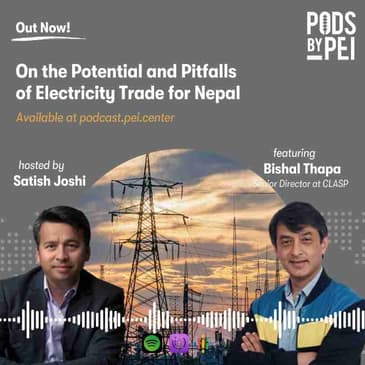
In this insightful episode, energy experts Satish and Bishal delve into the potential and challenges of electricity trade between Nepal and its neighboring countries. They discuss both the pros and cons, highlighting opportunities and risks while also examining the impact on Nepal's energy security, economic growth, and geopolitical standing.
About the Experts:
Bishal Thapa
With over two decades of international experience, Bishal has collaborated with a diverse range of public and private sector entities in the fields of energy, climate change, energy efficiency, environmental policy, and sustainability. Trained as an economist, his areas of expertise encompass financial analysis, quantitative modeling, policy evaluation, research, and project planning.
Satish Joshi
Satish has dedicated more than ten years to advancing Nepal’s electricity sector, focusing on issues from institutional reforms to electricity trade initiatives. As a founding partner at VRock & Company, he supervises the firm's projects in the energy arena. Prior to VRock, he served as the Principal Manager at the Investment Board of Nepal, spearheading negotiations for major hydropower projects like Upper Karnali and Arun-III. Satish has also been a previous guest on PODS.
Keywords: Energy Trade in Nepal, Hydropower Projects, Electricity Supply, Energy Security, Economic Growth, Geopolitical Implications, Public and Private Sector Partnerships, Financial Analysis, Policy Research.
[00:00:11] - [Speaker 0]
Namaste and welcome to Pods by PEI, a policy discussion series brought to you by Policy Entrepreneurs Inc. My name is Kushi Hung. In today's episode, guest host Satish Joshi from VROC and Company is in conversation with energy sector professional Vishal Thapa, to discuss the potentials and pitfalls of electricity trade. Vishal has more than twenty years of global experience working with a wide range of public and private sector partners across energy, climate, energy efficiency, environment, and sustainability. As an economist by training, his expertise includes financial analysis, quantitative modeling, policy, research, and project design.
[00:00:55] - [Speaker 0]
Our guest host Sathis has worked in Nepal's electricity sector for over a decade on issues ranging from institutional reforms to electricity trade. He is a founding partner at VROC and Company where he oversees VROC's engagements in the energy sector. Before that, he was the principal manager at the Investment Board of Nepal, where he led negotiations for the Upper Karnali and the Arun three hydropower projects. Satish has also appeared previously as a guest on PODS. We hope you enjoy the conversation.
[00:01:33] - [Speaker 1]
Much of Nepal's hydropower led development narrative is premised on Nepal being able to sell power to its neighbors. Now realizing this narrative seemed farfetched and almost mirage like while Nepal suffered from bio shortages for much of the last two decades. But that has all changed in the last five years. Load shedding is largely a thing of the past. Hydropower projects are coming online, and supply is beginning to exceed demand for now only during the wet seasons.
[00:02:07] - [Speaker 1]
But in a few years, we expect that to be year round. As a result, there is excitement and guarded optimism about power trade within the energy fraternity in Nepal. In our discussion today, we will be speaking about the case for and maybe against electricity trade between Nepal and India, but also between Nepal and Bangladesh and even potentially China. The potential and pitfalls of electricity trade, the modalities, and their implication on our energy security, the economy, and geopolitics. Vishal, welcome to Pods by PEI.
[00:02:47] - [Speaker 1]
It's a real pleasure to have you.
[00:02:48] - [Speaker 2]
Thank you, Satish. Thank you, PEI, for having me here as well, but thank you very much for inviting me to your program, and I'm looking forward to the discussion.
[00:02:57] - [Speaker 1]
Great. So am I. Michelle, I'd like to begin by unpacking the recent interest and enthusiasm about power trade because from what I know, trade between Nepal and India is really not a new thing. Nepal and India have been trading power since the 1970s, initially on a government to government mechanism, but more recently on a commercial basis since 2010. So really, what is different now?
[00:03:25] - [Speaker 1]
Why this enthusiasm and excitement about our trade? What is different now?
[00:03:30] - [Speaker 2]
Thanks, Satish. I think it's a great it's a great question. And I think what is different now is there's probably many layers to that, to what is different now. The first layer is is this notion that the electricity market in India has changed, and those are led by domestic changes. Over the last decade and a half, two decades, India has also witnessed its own changes internally to the structure of the marketplace.
[00:03:57] - [Speaker 2]
There's a thriving electricity market that involves trade, there's structures for real time trading, there's a lot more players into the business, there's been an effort to change the regulatory structure and underpinnings of the system. So it feels more open. There's a lot more international players along with domestic players. So it's a more active place. That's one.
[00:04:19] - [Speaker 2]
Along with that, people have long recognized that neighboring countries to India have an opportunity to be able to engage with India in in terms of the trade flows on electricity. Before, as you've noted, there was always, trade has been, electricity flows has been around for a long time. But maybe the kind of trade flows on electricity that was then displayed where it's both importing and exporting, maybe that wasn't there as much. And so there's been some effort to try to make this more systematic. And India has also approached it trying to think of its role in the leadership it can play in the region as somebody who could set up a hub.
[00:05:01] - [Speaker 2]
And so they've made efforts on regulatory situations in terms of the structural as well, both on the regulatory and structural, to evolve a more regional platform for electricity. And I think that's that's the changes. At the same time, electricity demand has been booming in all of the countries. Electrification, for instance, now across the region is pretty close to 100%. So there's clearly a lot more need for electricity demand in terms of the expected growth in electricity demand in the region.
[00:05:34] - [Speaker 2]
So I would say these are the kinds of changes that have occurred over the last two decades slowly. So the evolution of electricity market structures, the willingness of countries to look at the possibility of engaging with one another as with electricity as a commodity, and third, the fact that electrification has become important. And now with almost near universal electricity access, I think there's more an opportunity to use the opportunities and resources of neighboring countries to be able to fulfill demand. So those may be the set of factors. I'm sure there's many more, but at least those are the first few things that come to mind.
[00:06:14] - [Speaker 1]
There are a few skeptics about power trades but from my vantage point I think there's a strong case for trade. Nepal's hydro based generation produces clean electricity. When demand for electricity increases in India and Bangladesh, especially during the summer months, it enables integration of India's ambitious rollout of solar and other intermittent sources of renewables. And as a region it enables the transition to and helps countries achieve their carbon reduction goals. So many in the fraternity believe that India will buy all the power we can sell.
[00:07:04] - [Speaker 1]
Is that true or is there just more to that than that?
[00:07:07] - [Speaker 2]
I think let me try to unpack your question a little bit into pieces. I agree with your sentiment broadly that you started off that question to say that, look, trade is a good opportunity. There's no reason to be skeptical of it. But, you know, over the years, as I've written on the subject, commented on the subject both publicly and through my work, I have cautioned about the use of of trade. So I think that sometimes occasionally puts me in the category of being a skeptic.
[00:07:38] - [Speaker 2]
Although, personally, I don't I don't think of myself as a skeptic. I think it's important to recognize that there's clearly value to trading. If you have excess electricity or if you have electricity that you can sell to a neighbor or a customer, like, why not? Makes made awful sense. The the question is, and maybe the very first sentence that you opened it, like so much of Nepal's hydropower is premised on the idea of being able to sell to to India.
[00:08:06] - [Speaker 2]
And and I think that's where the narrative, you know, sort of begins to place people into these two categories. I think we would like, I would say that trade with India is important if you can certainly have the ability to generate electricity and sell into that market. It's great. But that doesn't mean that it means it should discount or undermine other changes you need to make at home, in terms of how you reform markets, in terms of how you make structure, you know, you change the structural environment of the sector, how you increase access, how you increase reliability. You mentioned load shedding is over.
[00:08:44] - [Speaker 2]
Load shedding is over, but there's still a lot of concerns about reliability and about the unevenness of supply. So I think trade itself is one parameter of how we evaluate the success of a sector, and specifically in Nepal that's going through its own sort of growth phase, its own development phases. Trade in electricity should be one element of it. The other elements also need to be evaluated as we think about what does electricity and hydropower and other sources of generation in Nepal do. So that's one aspect of the answer that I want to get.
[00:09:20] - [Speaker 2]
The second is, can India absorb all that Nepal can generate? Sure. I mean, I think the market in India is big enough to be able to to generate. We have, you know, what, now close to 3,000 megawatts. That's not even a decimal point to the volume of electricity that India has, and India's own development of hydropower capacity often outpaces what the coal can produce.
[00:09:46] - [Speaker 2]
So, absolutely, like, there there should not be any any limitations on how much Nepal can can export. The question is whether we have the infrastructure, the physical infrastructure to wheel it in, which might be a big a big question, and how we get there to having enough of it, and whether there's the willingness to move from this, you know, government to government approach on electricity trading to one which is more led by markets or is more institutionalized in market structures. And so just another point that I should I should add in there that I want to preface is that, you know, in the first question you had asked me what what I thought changed, and you mentioned that we thought we had evolved from a more government to government structure to a more structure which is more embedded within markets. And I think some of it is true, no doubt. But I think still the management of electricity flows across the country is a very government to government, you know, is led by governments.
[00:10:50] - [Speaker 2]
The role of markets and market institutions and structures in being able to dictate limited. The operational aspects of trade where it finally gets used, etcetera, may be driven by market structure. So we go and sell electricity in real time markets, etcetera. That's fine. But the entry and exit and the the larger infrastructure of how that trade is enabled is very much driven by governments, which reflect their own priorities that they have.
[00:11:22] - [Speaker 2]
Sorry, I think that was layering in many responses to what perhaps was somewhat simple question, but I just wanted to make sure that we don't oversimplify it.
[00:11:33] - [Speaker 1]
No, no, that's fine. And, you know, talking about markets and governments and the interplay between that. You know India has taken a very cautious and a phased approach to opening up its market right From G2G to now opening up the short term market. I think what would be really helpful for our listeners is if you can unpack for us what is it that we can now sell in India? I mean, it's electricity, but when, how?
[00:12:05] - [Speaker 1]
And then we'll talk a little later about the cautious approach that India has taken. Yeah. I think it's
[00:12:13] - [Speaker 2]
I may not be the best source to give what exactly that we can sell in India, and I'll I'll I'll preface that answer a little bit. I remember talking to some government representatives of Nepal right after, I think, the prime minister's visit and subsequent to that when there was a lot of excitement about how we'd signed the twenty five year deal to sell electricity to India. And and and they they indicated that there seemed to seem to be a firm, right, willingness to buy electricity. And I asked that person who bought it for 25 years. I was curious.
[00:12:49] - [Speaker 2]
I said a trader can't buy it. That's for sure. Like, I don't know any trader in India who's taken an open position on buying unless he's brokered at 25 mg, then I hadn't seen any of that happen. So I was curious, like, who exactly bought this? And I was reprimanded for asking questions that already, you know, that was basically for asking the the question when you're already been signed, apparently.
[00:13:14] - [Speaker 2]
And so I think the first thing that I want to to give out is that I don't really know the answer to your question, but I think it's very important that as we engage in this sector and in a way to overall enhance the quality of power trade and and to make it beneficial to members of our country, is that it's important governments also provide adequate information in a transparent way so we can also engage. Right? So so that's one part. Like, I think it's important, like, as as civil society commentators and as experts in the sector that choose to engage in some of these topics, we are reliant on the ability to have information. So if we don't have information, it's very hard to to relay information.
[00:14:00] - [Speaker 2]
And sometimes what you read in the press is, you know, it barely begins to scratch the surface. So which leads me to the crux of the question you're asking is that I think India's market is, yeah, you know, is is fairly is is getting a lot more mature. There's a lot more different types of products. And so my general take on it has been for the the poly electricity that is coming into India. Once you get into India, once you, like, enter the door, and once you get to the dance floor, you know, you pretty much get a dance based on whatever the rules is there.
[00:14:36] - [Speaker 2]
So you can sell in the spot market. You can set in the real time ahead market. You could, if you wish, engage in those beats that they have, which places it to short and medium term. So I think all those segments are are available. The how you get in the door is a different story.
[00:14:54] - [Speaker 2]
But in in some sense, I think the opportunity here for the Nepal, if it was to use the marketplace of India, is to be able to trade in sort of real time or near real time markets, which is the products that are defined. You could also enter into some bilateral agreements with certain sellers, and certain buyers through traders. That's the second segment and that could be slightly longer term. And then the third is it could basically participate through bids based on states that put out these bids every once in a while. So those are broadly the the three segments.
[00:15:33] - [Speaker 2]
One of the segment that I think Nepal has not explored that may be worth exploring, and I'm surprised that they haven't, is to look at this to look at customers that basically have ability for open access. And so these are large industrial commercial consumers that are buying in essence to meet their renewable purchase obligations. But there may be customers who are willing to to purchase at least hydroelectricity if it is bundled as open access stuff, which requires them to go sort of one layer below what is just available in the exchanges or in the standard bilateral deals.
[00:16:17] - [Speaker 1]
So, Vishal, let's talk a little bit about that. I think for some of our listeners, when you say open access, what does that mean?
[00:16:24] - [Speaker 2]
So, you know, they might be large. Today, many many consumers in India have the ability to be able to go and source electricity from multiple parties, and sometimes they do it, whatever, to reduce their supply. I mean, to reduce their cost or to meet other obligations for clean energy. Right? They could be an industry.
[00:16:45] - [Speaker 2]
It could be a large commercial complex. It could be anything that is a large load. So they may secure a a supplier to provide them that electricity, have a direct transaction with them, and essentially file for access to wheel electricity through the, you know, through the transmission lines and distribution lines. In the past, even though open access has been around for a long time, in the past, open access was seen as pretty challenging because states sort of imposed ineffective backdoor ways to prevent that through surcharges and other constraints. But over time, I think there's been significant easing on that.
[00:17:33] - [Speaker 2]
Just, you know, an anecdotal evidence. I was speaking with somebody who owns a bunch of cluster of small wind and solar in the state of Tamil Nadu, and he was explaining to me how now it's extremely beneficial for him. And he owns, you know, two, three megawatts of how he can bundle that, wheel it across to other customers, and sell it, and the price is really good relative to what he would sell otherwise to the state utility. And and it so I asked him how difficult was the challenge of acquiring the paperwork for the open access or getting the open access, and it seemed to indicate there'd been a real shift in that. And so, you know, it's important not to overgeneralize for one example.
[00:18:16] - [Speaker 2]
But in general, like, if it's becoming accessible for such small parties, like, it's certainly becoming a lot more like, there's a lot more of that going on. There are now entities that are helping and working with large consumers to help them source electricity to issue these bids. Right? So there's a lot of there's an industry that has evolved around. This like, if you were to ask me, you know, how does Nepal tap into the market?
[00:18:43] - [Speaker 2]
Like, this would be a real tapping of the market as opposed to just working through governments. As I said, you still need to get into the door. But once you get into the door, like, this would be a way to really tap into the market where there might be opportunities for this. The a lot of this challenge in Nepal is whether these kind of sales and these kinds of emerging sales opportunities can be bundled together to provide any sort of long term stability. So plans are essentially bankable and financeable.
[00:19:16] - [Speaker 2]
And I think that's where the that's where the the challenge comes in. Right? Even though opportunistically, these sales are great, you might make some decent amount of money. But does it give you the confidence that you would never build a plant based on the premise of this kind of sales, sales potential? It would be too much of a merchant plan.
[00:19:38] - [Speaker 2]
I don't think it could be financed, at least not in these conditions.
[00:19:41] - [Speaker 1]
So, Vishal, just to recap, I think we agree that there is a big market that's available in India for Nepal generators to tap. Getting into the door, we'll talk a little bit about how you get into the door, to the dance floor. But what you mentioned is what's really opened up right now are opportunities for short term sales. And then you also touched upon how you won't bank a project or be able to really finance a project based on these potential for these opportunistic sales. Is there a market to tap into that would make these asset intensive hydropower projects bankable?
[00:20:27] - [Speaker 1]
Is there a market to tap in India or is the market evolved from that?
[00:20:33] - [Speaker 2]
I would say that there is and I think that's where the disconnect between the operations about the tactical and the strategic comes. Right? Look. We have strategically decided we want to export to India and benefit from it. Fair enough.
[00:20:49] - [Speaker 2]
Right? That's that's the approach that we've taken. If that is the strategy you want to put in place, then you also have to put the tactical pieces in place to be able to do that. Right? You cannot you cannot, you know, sit on some hilltop, the Mount Everest, and then pretend you are, like, battling in the electricity markets of India, like, way down in the 20s.
[00:21:13] - [Speaker 2]
So first, you gotta show up. If you wanna dance in the dance floor, you gotta be at the dance floor. You can't be outside and then pretend you're dancing. The summer one. Second is, I think, as as a country, we have to recognize that we are dealing with markets, and markets inherently bring risks.
[00:21:36] - [Speaker 2]
Right? And in this initial phase, governments have to work with the private sector to figure out how to manage those risks because I don't think in the private sector alone anybody has the appetite to do it. Like, it's not even possible today to really project finance a hydro. Right? Like, truly project finance, nonrecourse project finance.
[00:21:59] - [Speaker 2]
It's not even possible. Imagine trying to do that with some kind of merchant contracting opportunity. It's just it's impossible. And so if you had to convert that, then you gotta start providing some kind of risk assurance mechanism, some kind of risk guarantees or whatever. All of this requires, I think, a a tactical approach that says, look.
[00:22:24] - [Speaker 2]
If this is our strategy, then we gotta get real. Right? India is not the country that was in 1960. Like, we are way beyond that. This is not a power market from even fifteen years ago later on fifteen years.
[00:22:37] - [Speaker 2]
It's not even a power market from, you know, five, seven years ago. So in order for Nepal to really take benefits of what it is, like, it has made an audacious strategy to be able to export into Nepal, it must have an equally audacious tactical plan of how to get there. And that means it stopped, like, being scared and figure out, like, how to arrive at this market. They gotta set up an office here. They gotta look at how to tap into capital markets here.
[00:23:08] - [Speaker 2]
They gotta figure out how to make the connections. You can't as I said, you can't, you know, you can't sit on some hilltop somewhere and then pretend you're in the, like, battlefield down in the planes. Right? That it can't work like that. So the answer to the question is absolutely yes.
[00:23:25] - [Speaker 2]
It can. And other people are doing it. Why not in the park? Like, this is the marketplace that's open if you believe in the marketplace. So we've decided the strategy.
[00:23:35] - [Speaker 2]
We need a tactical plan that is commensurate.
[00:23:39] - [Speaker 1]
Okay. So, Vishal, talking about the tactical approach, let's just unpack that. From, you know, my vantage point, the tactic that Nepal and its related actors on this side are taking is, you know, probably heard the government has relaxed optimization parameters for hydropower and they're actually going to open up the gates to sign more PPAs. So it seems like the tactical approach is NEA will guarantee long term contracts for power offtake and for every unit that it can use it's buying two units that it cannot. It's going to be surplus just given the nature of the generation profile of our power projects in Nepal.
[00:24:22] - [Speaker 1]
So in some ways the risk is being transferred to the state and now NEA has the burden of trying to trade this power in the Indian market through short term arrangements. That I understand is the tactical approach we've taken. Now it doesn't seem sustainable from what I can tell. And where is the role of the private sector in this?
[00:24:47] - [Speaker 2]
Satish, I think what you described isn't necessarily a tactical plan. I think that's the structural plan. Right? It's basically saying, look. It is going to, in effect, take an open position on all its buys, and then it's gonna figure out how to sell it.
[00:25:02] - [Speaker 2]
I mean, it seems to be a recipe for disaster to come in in the near future. I mean, nobody in India has even dared to take that position. It's it's daunting that somebody who's not even in this marketplace is taking that position. It's it's it's it's crazy. I mean, it sounds crazy.
[00:25:22] - [Speaker 2]
What I mean by the tactical plan is that you gotta figure out in the tactical plan, like, who all moves with you. It's like, if really we're gonna play into the market, like, why should NEA do this? Like, why should be NEA be the only entity in doing it? If you don't believe in a market and you are not willing to allow other people to engage in the marketplace, then why rely on a marketplace in the first place? So the basic tactical constraint that we have with the government is that the government says it wants to use the marketplace of India.
[00:25:59] - [Speaker 2]
But every time it needs to do anything, it just goes and talks to the Indian political system and hopes that, you know, the generosity of the Indian political system will somehow enable it to do it. But the power markets in India have changed. I mean, government is still very powerful. Don't get me wrong. But the whole the whole evolution of Indian power market has been to figure out how to move government more from a market player to a market regulator and a market creator and minimize their role in the day to day stuff.
[00:26:31] - [Speaker 2]
You know, the regulatory commissions are now quite strong. There's a lot more market players in there. Even state owned companies that are big players and dominant players in the sector are held to a certain standard. So you have to fundamentally set up a structure in which people are responsive and understand market needs. Right?
[00:26:53] - [Speaker 2]
In my view, NA has not demonstrated the DNA to be able to say that it's a credible market player in a true sense. It is a very credible government institution, no doubt. Right? It goes and talks to the power secretary. It has all those sorts of access.
[00:27:12] - [Speaker 2]
But can it really like, does it have the technical capacity and the capacity resources and the willingness to be really hardcore power traders that can set up in India and do business and take those kinds of things, it can't. So the where the tactical approach is failing is that you are relying on markets. You're thinking that markets will solve the problem, but it's a government vehicle that's supposed to transport is there, and I just don't see it. Right? I think, again, as I said, the the tactical has to be aligned to your strategic.
[00:27:46] - [Speaker 2]
Your strategic means that you're going to rely markets. Your tactical has to be that it has to rely also on market. We have to open it up. We have to allow more Nepalese companies to do other things. Like, NEA cannot exert its monopoly so that it is the only entity that's allowed to do business with this.
[00:28:05] - [Speaker 2]
The domestic power market in Nepal needs to be opened up. You gotta you gotta create market in order to engage with the market. Right now, it's the government, and every time it wants to do this, it just runs off to Delhi, you know, talk to the establishment and hope that some arrangement will suddenly fall on their laps.
[00:28:26] - [Speaker 1]
That's that's really interesting, Vishal. And and I agree with you that, you know, you can't have a strategy to enter the marketplace and then the vehicles that you use are non market based. But let's just unpack this a little bit. So right now the way Nepal's power structure is there is really no tradable power. NEA has locked in on long term contracts all the power that's being generated in Nepal.
[00:28:54] - [Speaker 1]
So talking about the tactical approach, is allowing more private actors to enter the space, How do you see that evolving within Nepal?
[00:29:03] - [Speaker 2]
I actually think Nepal is in a great place to be able to bring in more deregulation within its own marketplace. Right? And in some sense, if you want to prepare to engage with India and you want to prepare to engage in a South Asian electricity market, you've got to evolve first. Like, you have to have the structures in place. You have to have the market players.
[00:29:24] - [Speaker 2]
So even though NEA has you know, even though NEA owns some of these contracts, there is like, there's no reason why we couldn't move towards a pool. There's no reason why we couldn't move towards open access. There is no reason why we couldn't move to a devolution of political authority so that there is more NEAs in each of the provinces. Like, that was all the that is all feasible today. And there are many countries that offer examples of how this transition occurred.
[00:29:53] - [Speaker 2]
You look at, you know, Eastern Europe, maybe ten, fifteen, twenty years earlier. There are examples of how they evolved from very state owned structures to fairly market based structures, and they did it in a very interesting transitory way, right, that that opened up the marketplace, and some of them are now pretty well connected in Western Europe. You look at at Singapore, that is an extremely complex commercial market, but they came out from a period of pretty state owned ownership across many of the companies with long term contracts, and they used a very interesting concept of, you know, vesting that slowly sort of begin to die down. So there's many ways you could do it, and I think Nepal, for all its its structure, the fact that a lot of these investments are taking place today, the fact that we've have political devolution means that we also need a market in Nepal that reflects, a, its political context. Right?
[00:30:52] - [Speaker 2]
B, its social context, and, c, its economic aspirations in this thing. Today, the biggest like, for for me watching the sector in Nepal and when I engage with it, the the most disheartening part is that the power market is completely misaligned to what the political, economic, and social aspiration and realities. You see nothing. Right? We're stuck twenty years ago with, in effect, the state owned monopoly that has absolutely no interest in moving it and policymakers are not.
[00:31:28] - [Speaker 2]
But I think there's a lot of a lot of things that could be done to evolve the domestic marketplace through pooling systems, through kind of these contracts that are vested in it, through allowing people to use other sorts of retail deregulation. All of these are are possible, and they're specifically attractive today because of Nepal's political structure. There is an evolution of power that is taking place.
[00:31:54] - [Speaker 1]
I think, Prashanti, you made a great point, and from what I know, the government in Nepal is working on opening up the market. There is efforts underway to bring about open access even if it's in a phased approach and there's efforts to have more actors in the power trading market. So I think I'm hopeful that things are moving in the right direction but not as fast and not necessarily with the aspirations of the people and the country for sure. But I think about, you know,
[00:32:28] - [Speaker 2]
the Yeah. Before before before you move to the next point, sorry. I don't want to interrupt you, Jean, of thought, but I think one thing I do want one thing I want to say is that we're very reliant on government to essentially liberalize itself. Right? And that's like we're asking a monopoly to unmonopolize itself.
[00:32:47] - [Speaker 2]
That's like the you know, what is the incentive for that? So if we look across the country, I think one of the things that I see is is the responsibility we all have as civil society actors at other agencies. There is no counterforce that is trying to push this. Right? There is, like, you know, we're engaged.
[00:33:08] - [Speaker 2]
We all write this, that. But it it requires more than just, like, people dabbling in as a as a hobby. Like, you need a more systematic approach to making the case. You need a systematic approach. And and and particularly, like, as you said, it's not happening fast enough.
[00:33:23] - [Speaker 2]
The pieces are there. Yes. Absolutely. I also agree. And the reason it doesn't have happen fast enough is that there is no other force in Nepal that's trying to push for this.
[00:33:33] - [Speaker 2]
Right? There's there's nothing that is actively fighting for this. I I remember a few months ago, I I read the draft that had come out of the Electricity Regulatory Commission on Citizens Act, and I thought, oh my god. It's so great. At least there's an opening.
[00:33:49] - [Speaker 2]
But I just didn't see any convergence of force around really using that as an opportunity to open up, you know, the the retail segment a little bit of electricity. And so I think it's important for us to recognize that this change is not automatic. Like, NEA will not automatically, out of its generosity and good heart, do this. Right? The political establishment, out of its good heart, will not do this.
[00:34:16] - [Speaker 2]
There's way too much history, way too much institutionalized interest in there. So it needs a counterforce. And that counterforce, unfortunately, is missing.
[00:34:26] - [Speaker 1]
Vishal, thank you. I think I agree with you for the most part. The only counter that I would have is we're evolving from an NEA, which is the major actor in the space, which was largely underperforming for most of its history and in recent years has been doing somewhat better by any yardstick, whether it's technical, financial. I think we may disagree on the quantum of that improvement, but it's definitely been an improvement. And so is it a little premature to really rock the boat or should we ride this period of improved performance for a while before we look to deregulate the market, if you will?
[00:35:14] - [Speaker 1]
That's just a thought.
[00:35:16] - [Speaker 2]
No. It's a it's a it's a great question. I think, you know, I agree with you. There's there's a lot of improvement. Right?
[00:35:22] - [Speaker 2]
Like, hey. First of all, almost 97, 98% of the country is electrified. That's great. People have access. Load shedding has ended, as you said.
[00:35:30] - [Speaker 2]
I mean, it is challenges of reliability. NEA is profitable. And so those are all those are all great things. But I think the I remember being in a workshop once and and asking people, you know, there's a bunch of any friends, not friends, but people who work there, and and asking a question what what everybody's what they thought was any of his greatest assets. Yeah.
[00:35:57] - [Speaker 2]
And people said, man, there are different things, etcetera. And then they came down and said, mister Kool Manuki Singh, the managing director, is the greatest asset then. Absolutely. Right? Like, he is the greatest asset.
[00:36:08] - [Speaker 2]
So when everything is going well, he has the most political capital to make these changes. It is in times like this that he can make the change and make it sell. Right? And this is the disappointing. Like, we expect a utility to do this.
[00:36:25] - [Speaker 2]
Right? It's supposed to electrify us. It's supposed to give us good electricity. It's supposed to be profitable. Like, this is this is what it's supposed to do.
[00:36:34] - [Speaker 2]
Okay. It's done that. Well, you know, it's great because many of other institutions are not working, but that doesn't make it extraordinary. This is the baseline. The question is how can we how could they capitalize on this?
[00:36:46] - [Speaker 2]
Right now, if NEA led a movement that says we're gonna reform, who would stop it? Literally, who would stop it? Right? Nobody. So the difference between being good and being absolutely great, and I guess that goes to, like, personalities as well, is you gotta learn when to use your political capital.
[00:37:07] - [Speaker 2]
And this type of political capital doesn't come often. And I think and I I'm it's basically, like I said, right, it's it's a plea that, you know, that that you're asking the one with the authority to basically devolve authority. It's a tough ask. It's a tough ask. But I think this is where we've also you know, it's like we've been stuck with so many years of failures that even the basic successes is so dramatic for us.
[00:37:40] - [Speaker 2]
And it's great. Like, I applaud it. I mean, I I don't think it is without challenges. I know, you know, knowing many of the individuals out there, it's all a great set of individuals. Everybody wants to make change.
[00:37:51] - [Speaker 2]
They want to do stuff. So it's it's a great set of successes, but that from being good to great is where that I think can use this opportunity and make the changes.
[00:38:11] - [Speaker 3]
Hi there. This is Shia Rana from Policy Entrepreneurs Inc. We hope you're enjoying Pods by PEI. As you know, creating this show takes a lot of time and resources. We rely on the support of our community to keep things going.
[00:38:24] - [Speaker 3]
If you've been enjoying the show and would like to help us out, we'd really appreciate it if you could become a patron on Patreon. Patreon is a platform that allows listeners like you to support creators like us with a small monthly donation. Your support will go a long way in helping us to continue creating high quality content for you. So if you are interested in supporting our show and becoming a part of our community, head on over to Patreon and become a patron today. You can find us at patreon.com/podsbypei.
[00:38:55] - [Speaker 3]
Every little bit helps and we can't thank you enough for your support. Now, let's get back to the episode.
[00:39:06] - [Speaker 1]
I think so we've dealt a lot on the things that we can do at our end. And I just want to go back to your analogy about getting to the dance floor. Now, door through that to that dance floor is, let's unpack the legal and regulatory regime that enables us to enter the dance floor. There's a concern on the Nepal side, even on other countries in the region that that door is controlled by India. Now if you review all the recent agreements and regulations that have come out that enable this access to the energy market, I think it's quite clear that India intends to have control over that and there must be some valid reasons.
[00:39:54] - [Speaker 1]
But for those of us that are sitting on the other side waiting to get in, it does feel like India has discretionary authority about who comes in and answers or not. And that creates uncertainty for developers of power projects. Can we just dwell a little bit on why India has taken this approach? I'm sure there's valid reasons for it. But sitting on this side, we fail to sometimes probably appreciate and understand.
[00:40:22] - [Speaker 2]
I think the first thing is to basically agree with you that, look, they're you know, getting into the door does require you to get the consent of the government. Right? So there is a lot of discretionary authority that is applied, and the way that the rules are written appears to make that quite clear. And, also, then in practice, the way it happens is that it's it's I think it's quite clear. Once you get in, the rules are are are pretty robust.
[00:40:50] - [Speaker 2]
And, you know, once you get commercial agreements and you find, like, somebody has not lived up to their commercial agreements, the legal system in India with the courts and others are a very good fallback. So I think there's certainty on that. It's like how to get in, as you said. I think it's hard to to even speculate, like, why India might have chosen to do that. I mean, the electric sector is still a very, very important one that has much, like, in terms of security concerns, in terms of social concerns, political concerns.
[00:41:22] - [Speaker 2]
So I think it might be a whole variety of different factors that go into the push and pull that I'm sure is there in sort of making these rules. But in general, I think it's not something that should have surprised us, and this is where I feel like the, you know, Nepal's own understanding of how it approaches this needs to evolve. It's you know, of course, it's like, you know, it it we've we've attempted to believe we attempted to believe that you could take this away from governments and make it truly, like, market based, right, at least the entry part. And I think we've come to realize that that's not possible, that it is heavily intertwined with political and foreign affairs, and it gets more complex because of the challenges that are there now in the geopolitical environment. And I think a great example like, it we knew this from history.
[00:42:16] - [Speaker 2]
Like, if you see the story of the first interconnection lines that when Nepal runs, I think it was, like, 02/1967. I can't remember the exact date, but somewhere in that time frame, right, when Nepal signed with INLFS, and it was this big announcement NEA had, and they're gonna build four transmission lines, etcetera. Like, you remember that story. Right? There was a time of great, like, euphoria and excitement, only to discover that when it got to India, India said no.
[00:42:45] - [Speaker 2]
ISLNFS is not going to do it, and government needs to own the company that would build this transmission line. End of story. Right? It took six years after that to basically hand over that and set up that Indian committee for CRC to approve that Indian company, and that is the company that ultimately built the line. When it actually built the line when it actually built the line, it took eighteen months to build the line.
[00:43:11] - [Speaker 2]
It was the fastest anybody had built a transmission line of this scale, but it took seven years for it to change ownership from INLFS to this company that was set up, that was a consortium of Indian government owned companies, etcetera. So it's pretty clear that it is, and and I think our hope that, you know, it it devolves or it separates itself from foreign affairs and geopolitical considerations and all of those other things, I think isn't happening. Like, we know that around the world, energy is, like, heavily intertwined with that subject. So I think the the only thing that we can do is Nepal must also evolve its own thinking on how it manages the political implications of its energy integration. And I think this is where it needs to also get real.
[00:44:05] - [Speaker 2]
Like, the nature of this energy integration has also changed in a very fundamental way, I think, the dynamics of Nepal's, you know, foreign policy and its political situation vis a vis the geopolitical context. And so because it has changed that, it it needs to now align itself to figuring out how do you manage this sector given that it is so heavily intertwined. Like, we need a smarter approach. We need an approach that's more consistent with reality. We cannot expect that energy officials can strategically decide this when we know that the real decision maker exists within the external affairs.
[00:44:53] - [Speaker 2]
So I think this is where we need to align to what this new paradigm means, and it also means some rethinking needs to happen on what the integration of energy does to its foreign affairs and foreign politics.
[00:45:07] - [Speaker 1]
Vishal, that's a really interesting point because at this stage, we're in many ways just beginning a journey and that intertwining of our electricity markets will get just more complex and just by the sheer quantum of power that could potentially be flowing across our borders. Being smart politically is going to be, I think, very key in mitigating the risks associated with it.
[00:45:37] - [Speaker 2]
Yeah. Absolutely. And So And as you as we're hearing, you know, right now, there's all this talk about transmission line of the North. Right? And so that just adds another dimension to it.
[00:45:47] - [Speaker 2]
Like, it's hard now to disentangle some of these things. And even though, you know, we might want to sort of treat it at face value, oh, yes. We'll have transmission line. Makes all good sense. Right?
[00:45:59] - [Speaker 2]
It's it's hard not to get it colored by geopolitics. Right? And so what does it mean now? Like, that this potentially could be and, you know, the prime minister has already spoken. Other members have already spoken.
[00:46:12] - [Speaker 2]
But it it comes as a little bit of a surprise. And so has there been adequate thinking to what all of this means? So it you compliment if like, Nepal is a very, you know, obviously, small and very vulnerable to many of these influences. The nature of the sector compounds that vulnerability. Right?
[00:46:34] - [Speaker 2]
And and I get this is what, for me, has been the one of the things that I've sort of watched over the years is that as a as a country overall, you've got to figure out how to manage some of these vulnerabilities. Right? Like, we're surrounded by big powers. There's a lot of influence at play. And so how do we try to create some kind of boundaries so that we find safer spaces for ourselves and for our domestic priorities?
[00:47:02] - [Speaker 2]
And these kinds of announcements, oh, we're just gonna have lines here. We're gonna have lines there. Oh, now we're gonna do this. Just sort of compounds it. It just aggravates the vulnerabilities.
[00:47:12] - [Speaker 2]
And and I think that's my concern and what I see as a big risk moving forward.
[00:47:17] - [Speaker 1]
I could agree with you more, Michelle. I do feel like, you know, balancing and being stuck in between two superpowers is a delicate balance but I think we need to be probably a lot more thoughtful, calculated in how we approach this. You're in Delhi, you have a pulse on the power sector there. The recent announcements or rumblings about a potential power trade agreement and there's always been talk about connections with the grid with our northern neighbor China. Could that jeopardize what was already quite a fragile situation in terms of our trading arrangements with India.
[00:48:07] - [Speaker 1]
Do you see ramifications out of that?
[00:48:10] - [Speaker 2]
I don't know. Mean, it's hard speculate. It does feel like I guess because Nepal is small and it's trading it's engaging with a partner that's significantly larger that holds, obviously, a lot more levers. It's you know, sometimes a small thing can be cast as being, like, in response to something else. Our whole national experience, collective experience during the blockade, like, was it a blockade instituted by India?
[00:48:42] - [Speaker 2]
Their answer is no, but, you know, everybody in Nepal feels that it was. So who knows what the reality is. Right? So and and also in this case, who knows what the response is going to be? And so it's it's hard to say what it is, but I think in general, like, think what we can say is that, look, this is a this is a time of very sensitive geopolitical considerations.
[00:49:07] - [Speaker 2]
Right? You know, g twenty is gonna happen here in a few days. There's sort of alignments and realignments taking place all the time. There's a big concern about security in the power systems. I know a couple of years back, I think some of the papers reported on a blackout that may have been triggered by external external forces just as a warning sign of, like, how vulnerable they were.
[00:49:34] - [Speaker 2]
Right? And so was that real? I have no idea, but it was certainly reported. So I think we need to wake up to those realities, and this is why, like, unthought, you know, just rapid fire from policymakers from the highest level does not work in a situation like this, particularly when you I I guess one of the things that I've noticed I'm just gonna take a sidebar here. But one of the things I've noticed, if I look at evolutionary changes in the power sector in India versus the in India, one of the things that you can see as this evolution is taking place is that you see a momentum building.
[00:50:16] - [Speaker 2]
Right? The people writing about it, the people working on it, the people doing research, like so when it actually comes to a head, like, there's quite a lot of trail on it. Like, you can see that it it has galvanized a certain part of the population. In Nepal, that's absent. Like, it's just an announcement that's made, a strategic and a very, very high implication announcement that's made, and you don't see anything, which if you're looking at it from the outside, you can tell that it's a country that's very sensitive to power.
[00:50:48] - [Speaker 2]
Right? Like, if you have influence, you can pretty much decide anything you want without really having to think through the ramifications of it, and so that compounds your vulnerability. So the the point that I'm trying to say is I don't know the question to what will what India might do in response to some of these announcement, and I don't even know how real some of these announcements are. But I do hope that, you know, everybody keeps calm because I as I said, like, I I haven't seen anything, but maybe there's more substance behind these announcements than there appears to be. But is is to see if you know, to to encourage, I guess, everybody to open up this dialogue at multiple levels.
[00:51:29] - [Speaker 2]
Like, there must be engagements that everybody ought to be having at, you know, track b, track c with civil society, with industry, with market players. And I
[00:51:39] - [Speaker 1]
think
[00:51:40] - [Speaker 2]
industry associations, you know, experts like yourself, bilaterals, neutral bilaterals, multilaterals, think, must do more to try to encourage these cross border communications and these cross border exchanges because it's hard to build a real sustainable interconnectivity unless you're also connected at that level. I don't know. That was a very long winded answer to your question, I think.
[00:52:08] - [Speaker 1]
That was very thought provoking Vishal and thank you for that. We're almost at the end but I don't think I'd be doing justice to this topic if we were to just slightly touch upon the market for electricity beyond India now. All roads out of Nepal to other destinations go through India and the one market that you know there's been substantial discussions at multiple levels is Bangladesh. Can you just in conclusion just talk a little bit about how we could access that market especially when you know why would India want us to sell when they could sell it to Bangladesh as they have been. But what is the opportunity for Nepal?
[00:52:52] - [Speaker 2]
I mean, I think, you know, it's great to be able to sell to Bangladesh. Bangladesh has been I've been in Delhi now for what, like, to sixteen, seventeen years. Right? And in fact, the very first assignment I did back in 2005 was to try to explore Bangladesh's interest to buy electricity from India. It was at that time.
[00:53:11] - [Speaker 2]
It was still proceeding. So, clearly, there's a lot of need for Bangladesh in terms of power capacity, in terms of generation need, etcetera. Can help satisfy that. Whether it comes from Nepalese hydro, it comes from India, but I don't know. But India is obviously the conduit.
[00:53:27] - [Speaker 2]
So I think it's a great potential. I think it's it's great that there's been discussions that have been initiated that looks at how Bangladesh itself could invest in some of these highlights as I think I've heard some of it a little bit. Also, how the three governments are all at the same table sometimes trying to talk about how to make this happen. I think for Nepal, the you know, again, it's about the tactical. Right?
[00:53:54] - [Speaker 2]
Like, how do we approach this? I think we can ask all we want to build a total right of way, you know, straight transmission line from Nepal to India. I think it's, like, 17 kilometers at the chicken neck in India, the point where the two countries come closest. But it's not gonna happen. Right?
[00:54:11] - [Speaker 2]
I mean, it just seems impossible. The point is India is a good hub. So what I don't understand really is from a structure point of view, if if the hub is India where the exchanges are, what's blocking people from coming and doing the transaction there? Right? Like, this is how all exchanges work.
[00:54:32] - [Speaker 2]
Like, many parties come there. And then from there, the physical lines go. So to be honest, I have always been baffled by what it means for Bangladesh to buy directly from Nepal. I mean, you would still need somebody to broker it in India. Right?
[00:54:49] - [Speaker 2]
And for the contract to be based in India. Like, for example, if you take Singapore, all sorts of energy contracts are based there, but the flows are happening all over the, all over the place. So in a similar vein, like, if the contract is based in in India, like, what does it mean that it it's flowing from Nepal to Bangladesh? I mean, does it bypass India? I don't know.
[00:55:15] - [Speaker 2]
It simply means that it's going from one party to the next to the other, or is it that the idea is that Nepal itself is the counterparty that sells to Bangladesh? I don't know. And I think one of the reasons that I struggle in in that segment is because I just feel like enough information is not provided. Obviously, I know I'm not privy to the internal discussion that takes place between governments, but I just encourage our government to be a lot more transparent in how they describe it so we can also look at it and and comment, and, hopefully, it will be valuable to them. But that information is very cagey.
[00:55:50] - [Speaker 2]
It's very difficult to understand. And and because of that lack of information, I just don't know how it's structured. But I fundamentally, I don't see really the challenge. You know, the two countries are connected. There's a central hub.
[00:56:01] - [Speaker 2]
You have a trade here, a trade there, like, two back two back trades. Like, what's the problem? And I think Bangladesh buying from Nepal isn't going to be any more preferential than it buying from the hub. Right? If it's cheaper, it'll buy from India.
[00:56:14] - [Speaker 2]
If it's cheaper, it'll buy from Nepal, and, hopefully, we can beat the competition in India and sell it to Bangladesh and be good for Bangladesh. Be good for Nepal. It'd be good for the traders in India. Like, everybody benefits. That's the whole point of trade.
[00:56:27] - [Speaker 2]
So I don't fully get it, but the reason I don't fully get it is I don't think there's enough information out there.
[00:56:33] - [Speaker 1]
Well, Michelle, I think that's all we have time for. I think we could go on and on.
[00:56:39] - [Speaker 2]
Yeah. Yeah. Yeah. I'm sure we'll have we'll have many opportunities to go on and on, but that might be outside the microphones.
[00:56:45] - [Speaker 1]
Thank you so much Vishal. It's been a really I can't even imagine that it's been an hour. So thank you and until next time.
[00:56:54] - [Speaker 2]
Okay. Thanks very much, Satish. Thanks for taking the time and those questions, and thank you very much for including me in your conversation.
[00:57:08] - [Speaker 0]
Thanks for listening to Pods by PEI. I hope you enjoyed Satish's conversation with Bishal on the potentials and pitfalls of energy trade. Today's episode was produced by Neerjun Rai with support from Hitesh Sapkota, Sonia Jimmy, and me Kushihang. The episode was recorded at PI Studio and was edited by Nerjen Rai. Our theme music is courtesy of Rohit Shakyuk from Sindhabad.
[00:57:32] - [Speaker 0]
If you like today's episode, please subscribe to our podcast. Also, please do us a favor by sharing us on social media and leaving a review on Spotify, Apple Podcast, Google Podcast, or wherever you listen to the show. For PEI's video related content, please search for policy entrepreneurs on YouTube. To catch the latest from us on Nepal's policy and politics, please follow us on Twitter tweet2pei tweeter2pei on Facebook policyentrepreneursinc. You can also visit pei.center to learn more about us.
[00:58:08] - [Speaker 0]
Thanks once again from me, Kushi. We will see you soon in our next episode.