
In February 2020, just two months into the Covid-19 Pandemic, the World Health Organization announced another contagious threat to humans, an infodemic. They defined the phenomenon as an excess of information, including false or misleading information, in digital and physical environments during a disease outbreak. Today, almost a year after the pandemic ceased, the infodemic persists. The global information system remains plagued by fervent misinformation that percolates and continues to intensify whatever outbreak it covers.
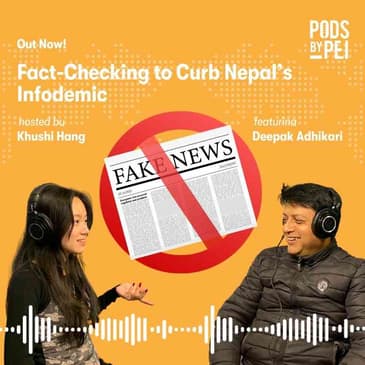
In this episode, Deepak and Khushi discuss the Nepali media landscape, particularly in light of the worldwide infodemic wherein dubious information is excessive. Deepak draws on his extensive background in journalism and fact-checking to discuss how Nepali media has evolved and the contemporary issues it faces as new digital media dominate its grounds. They discuss instances of deceptive and manipulative disinformation he discovered online during the recent elections and the pandemic and analyze how misinformation exacerbates sensitive subjects by intensifying people's reactions to them. The two end by exploring possible collective action to instill integrity in our media and garner vigilance in Nepali audiences.
Deepak is the editor of Nepal Check, an independent, non-partisan fact-checking platform. He was the editor of South Asia Check, Nepal’s first fact-checking outlet, and has worked as a correspondent for international news agencies like AFP, DPA, and Anadolu Agency. His work has appeared in major international publications such as the New York Times, The Guardian, Time, Al Jazeera, and Nikkei Asia. He currently focuses on innovations in fact-checking and digital investigation.
Click here to support us on Patreon!!
[00:00:05] - [Saurav Lama]
Namaste and welcome to Pods by PI. A policy discussion series brought to you by Policy Entrepreneurs Inc. My name is Saurav Lama. In today's episode, we have PI colleague Khushi's conversation with Deepak Adhikari on the importance of fact checking in Nepal's Infodemic. Deepak is the editor of NepalCheck, an independent non partisan fact checking platform.
[00:00:25] - [Saurav Lama]
He was the editor of South Asia Check, Nepal's first fact checking outlet and has worked as a correspondent for international news agencies like AFP, DPA, and Anadolu Agency. His work has appeared in major international publications such as The New York Times, The Guardian, Time, Al Jazeera, and Nikkei Asia. He currently focuses on innovations in fact checking and digital investigation. In this episode, Deepak and Khushi discuss the Nepali media landscape, particularly in light of the worldwide infodemic wherein dubious information is excessive. Deepak draws on his extensive background in journalism and fact checking to discuss how Nepali media has evolved and the contemporary issues it faces as new digital media dominate its grounds.
[00:01:08] - [Saurav Lama]
They discuss instances of deceptive and manipulative disinformation he discovered online during the recent elections and the pandemic and analyze how misinformation exacerbates sensitive subjects by intensifying people's reactions to them. The two end by exploring possible collective action to instill integrity in our media and garner vigilance in Nepali audiences. We hope you enjoy the conversation.
[00:01:33] - [Khushi Hang]
Welcome to the show, Deepak. It's so nice to have you here today. How are you feeling?
[00:01:38] - [Deepak Adhikari]
I'm feeling good. Thank you for inviting me.
[00:01:40] - [Khushi Hang]
Let me begin this conversation by first focusing on the phenomenon dubbed infodemic. As a media professional, how have you understood this concept of infodemic or what you often refer to in your articles as an information disorder?
[00:01:54] - [Deepak Adhikari]
Infodemic is a term popularized by WHO after the COVID-19 pandemic. Basically, the idea is that after the rise of COVID-19 pandemic, the miss and disinformation, those terms I'll I'll define later, went viral. Like the virus, which spread across the world, the information, the false, bad, incorrect information also spread as rapidly as the virus. So that's where the term came. But in fact, it was coined by an American columnist, I think in 2013, the term Infodemic, which, later on the UNWAO embraced, and then it it it became really a popular phenomenon.
[00:02:34] - [Deepak Adhikari]
But I wanted to talk about information disorder because to me, this is a really a growing problem across the world. So, to make it very simple and basic, let's categorize information into two types of, you know, bad information and good information. Under bad information, we can create subcategories like misinformation, disinformation, and malinformation. Under good information, we can define it as as something which is accurate, which is credible. So when it comes to the information disorder, these three terms, misinformation, disinformation, and malinformation are important because unless we define the problem, we cannot identify and debunk or tackle those.
[00:03:22] - [Deepak Adhikari]
So misinformation is simply a mistake. We all are victim of misinformation. We all spread unknowingly unwittingly, you know, that we like a photo a video a meme status. That's a mistake, you know, we usually do that. But more dangerous is disinformation, which is a deliberate spread of false or incorrect information.
[00:03:43] - [Deepak Adhikari]
And then there is mal information, which is more dangerous than disinformation, which which is sharing your private information. For example, revenge porn, you know, your your private data. So these are the broadly three categories. I'll talk about them, you know, in more detail later on, but I think we have a lot of false and misleading and incorrect information that circulates on on social media platforms and through traditional media platforms.
[00:04:13] - [Khushi Hang]
Right. So bringing this discussion home and trying to understand more of the impacts of new media and the disinformation that it enables, would you please first explain the current scenario of information systems in Nepal? How is the contemporary Nepali media structured? And not just the structure in terms of the media institutions and the disseminators of information, but also from the perspective of consumers and people who are receiving these information and interacting with them. What is their capacity in media literacy right now?
[00:04:49] - [Deepak Adhikari]
So back in the days, it was mostly radio and television and newspapers that people usually got information from. But as I said earlier, over the last ten years or so, this has really transformed. And now the social media companies have taken over the information ecosystem. Although credible and accurate, professional information is still you have to rely on the legacy media for that because the social media the information through the social media platforms, it's like a free for all. There is no filter system.
[00:05:22] - [Deepak Adhikari]
There is no ethics. And it has really complicated things because earlier you could have relied on a on a really professional media house with a long experience of delivering accurate and credible information. But now is with so much of information, getting out and also so much twice with the consumer because when Internet arose, you know, it it was considered a force for good. We thought that this is a rivals. Everyone would have access to information, and this is really great.
[00:05:50] - [Deepak Adhikari]
Even after the rise of social media companies, we thought that, okay, everyone would be connected. There'd be so much fun, so much, you know, connection and coming together and communities, but we always fail to understand the algorithm, you know, algorithms behind that. The these are companies. These are tech giants. These are profit driven.
[00:06:08] - [Deepak Adhikari]
In the beginning, we really create a lot of hope, and after a decade or so, we realize that it's a false hope. We become disappointed. But I think we, as someone who is embracing a new technology, we really become enthusiastic, and that that is a false kind of, starting. So what I want to say is the consumers now have a lot of choices. But, the credible, accurate information is at a premium.
[00:06:31] - [Deepak Adhikari]
That's because you have to spend a lot of money, resources. You need to build a generation of really well trained, professional journalists to provide accurate, credible, nonpartisan information. And that is something we are really struggling with because you have so much. There is a flood of incorrect information out there, and people are consuming that because we we are again, we are very far behind in terms of digital literacy. Rather than media literacy, I would like to use the term digital literacy because these are digital platforms, digital devices.
[00:07:03] - [Deepak Adhikari]
So we have we have a lot of work to do.
[00:07:06] - [Khushi Hang]
Understand that an infodemic is a vast phenomenon and so are its scopes. So maybe as we try to comprehend this in this very short discussion, maybe a good point to start would be with a discussion on the latest election cycle in Nepal. How would you evaluate the level of disinformation in electoral politics? And maybe you can give us some specific instances of disinformation that you observed and how you think these impacted the electoral process.
[00:07:37] - [Deepak Adhikari]
Thanks for this question because actually Nepal Check, we launched it in order to start seeing at election misinformation to experiment and to experience how we can debunk it and then what would be the magnitude, the scope of emission, disinformation around elections in Nepal. And I was at Panos South Asia when there was local elections. And there were some incidents, but not much because there's, like, so much across the country in municipalities and local bodies. So that was scattered, we did not experience much. But before the general elections, you know, before the November twenty elections, there's a lot of misinformation.
[00:08:15] - [Deepak Adhikari]
I can provide you with few examples. For example, on the 19th, a day before the actual election, in the early morning, I I was checking my Twitter and Facebook, people were sharing screenshots of news reports which claimed that the Nepali Congress party, which was then ruling party, was as had sent a secret circular urging their voters not to vote for the Maoist candidates. And so it was a kind of a double disinformation. One, the Nepali congress party had never conducted any such meeting where it decided to send a circular to his supporters. Second, based on that fake circular, they had created a screenshot of news reports published in leading digital outlets as well as an issue.
[00:08:59] - [Deepak Adhikari]
It was Setopati, OnlineKhabar, Ujyalo online, then Naya Patrika, and I think Rato Pati as well. So that was really a peak of, you know, election mis- and disinformation in Nepal. We obviously we debunked that because we were waiting for something like that to happen, really debunked this false manipulative content. And there was another one which many people did not may may not have heard about. So there is a a fact checking organization called Bishwas News in India.
[00:09:27] - [Deepak Adhikari]
And there was another screenshot which claimed that Bishwas News had published a fact check about Nepal's election in which it had predicted that KP Oli would win the election. UML would win the election, and India had sent a special task force to Nepal. That information published by a fact checker. We certified by IFCN, International Fact Checking Network, which is the global, you know, body that certifies fact checkers across the world. So I think these two examples were really extreme form of manipulation, political disinformation around elections in Nepal.
[00:10:02] - [Deepak Adhikari]
And it was shocking because it revealed that even in Nepal, people who go to that extent would create such a sophisticated form of manipulated media in order to mislead people. And that would really hit the, you know, electrical integrity because people could be mislead into not voting for their candidates, the coalition candidates. That means it's undermining electoral entry.
[00:10:29] - [Khushi Hang]
In terms of electoral processes, another question that I have is regarding the rising prevalence of populism and populist strategies. Would you agree that the vast publicity opportunities provided by the new media which often seek instantaneous popularity or what is termed as going viral is fostering populist practices in Nepali politics?
[00:10:50] - [Deepak Adhikari]
Yeah. It's it's an interesting, phenomenon, and we have seen this in Nepal. I would attribute the rise of Ravi Lamichhane as in it to this exact social media manipulation. Because if you see his trajectory from a TV, you know, show host to a politician and his popularity. Is it clear, you know, indication that his rise became possible only through manipulation of these platforms?
[00:11:14] - [Deepak Adhikari]
If you go to Facebook, you will see, like, hundreds of pages dedicated to Ravi Lamichhane. Ravi Lamichhane fan base, this, that. And later on, there were Balen Shah's phases. And there is whole a cottage industry of what I'll say conspiracy theorist who thrive on talking about populism, talking about nationalism. So I think this is a really a dangerous trend.
[00:11:35] - [Deepak Adhikari]
And if you see across the world from Trump's America to Bolsonaro's Brazil to even our neighboring India, populist politicians are good storytellers, and they know how to use social media platforms. They are good orators. They are communicators. And if you are good at those platforms, if you know how to use that, how to tell a story, basically, then you can amass huge following. You can influence people.
[00:11:59] - [Deepak Adhikari]
And the rise of populist politician across the world is behind that. I think there is this rise of social media platforms, and this is something we really have to be worried about. It's really getting alarming in Nepal as well as across the world.
[00:12:13] - [Khushi Hang]
Talking about alarming instances, another major event in recent times that exemplified the depth of the infodemic in Nepal was perhaps the public debate over MCC. In a meeting with senior editors of the Nepali media for our research on Nepal's infrastructural diplomacy, we were told that the role of agenda setting in these cases have been taken over by new media platforms such as YouTube and social media platforms such as Facebook and Twitter. Was this your observation as well? And what do you think are the dangers of letting new media become the new flag bearers of information becoming the major sources of information from where public gets their news?
[00:12:53] - [Deepak Adhikari]
I mean, the I think that's that assessment is accurate. I think it's also failure of the mainstream or legacy media. Because in this digital age, you cannot just say that, you know, okay, this is not our domain. This is social media. This is YouTube.
[00:13:07] - [Deepak Adhikari]
So we are not responsible. You are talking about the information ecosystem. So anything that gets amplified through YouTube or, you know, TikTok media should actively debunk that. Traditional media should fact check that. Then only you can create a clean and good information environment.
[00:13:24] - [Deepak Adhikari]
On MCC, I have a few points to make. I think, largely the traditional or legacy media did a good job, in communicating information about MCG. But as you rightly pointed out, it was the alternative other social media platforms and YouTube, TikTok, Facebook, where as I said earlier, people increasingly get the information through that those channels And the manipulation happened there. There were people, so called intellectuals who were spreading conspiracy theories about US army coming year or, you know, Nepal being under The US legal system and and all sorts of geopolitical fear mongering. And you have to understand this.
[00:14:03] - [Deepak Adhikari]
It's there's a background to this because Nepal's politics is largely dominated by left parties, and the left parties have amassed their following through nationalism. And in Nepal and in many countries, developing countries, nationalism means anti Americanism or anti Indian Expandedism. So these are the words they frequently use. So you have generations of Nepalese who grew up being ultra nationalist. They're fed into this, you know, narrative of Nepal never being colonized, the brave Gurkhas, and, you know, beautiful country.
[00:14:37] - [Deepak Adhikari]
So although that's to some extent that may be true, but once you start feeding the populace with this this kind of hyper nationalist theory and ideas, then you tend to see foreign powers as really, you know, conspiratorial. Then also there's another side too is which these people think that Nepal is really vulnerable. Nepal is really weak. So any foreign power can come here and you know occupy. So there is this fear as well.
[00:15:02] - [Deepak Adhikari]
And then you have to see from another perspective as well. Why do people create an hour long video on YouTube? So there is this component of monetize. People are really tech savvy. They know how to use, your your mobile as a camera or they know about the the social media company's work.
[00:15:20] - [Deepak Adhikari]
And if they can monetize it, they are willing to create any type of content and that's where issues like MCC issues like popularity of Ravi Lammichhane and it you name it anything that's controversial. That is clickbait. That is sensational. You know, you get a lot of views and then after you get a lot of views, you you can monetize. So there is this the idea of monetization as well.
[00:15:42] - [Deepak Adhikari]
So you have to connect that as well. It's not just foreign powers or, you know, some conspiracy theorist or all the nationalist talking about against these projects. You know, there are other factors as well. And last point I want to make is now these companies are based in US, mostly in Silicon Valley. These are American company.
[00:15:59] - [Deepak Adhikari]
So in a way, the buck doesn't stop in Nepal. It goes back all the way to US as well. So do they moderate this content? It's their platform. These are these things are happening on their platform, but because these companies are really profit driven, they are only for profit.
[00:16:13] - [Deepak Adhikari]
So they don't have incentive to counter this false and, you know, misleading information circulating on their platform. They just ignore it Or even if they do something, you know, it just for the sake of doing it, they are not serious about countering this and disinformation which is happening through their platform. Because the business model is that I always say that's, the the this new media or, you know, social media companies are built around two a's, which is amplification and attendance. And the idea of novelty. Now you are publishing videos, graphics, and content, which is sensational, which for hours and hours, people just people are hooked, you know, they really love it because there is demand.
[00:16:51] - [Deepak Adhikari]
You know, we also have to look at, as I said earlier, demand in the supply side and you are making money so that social media companies want people's attention and you are getting that and to that you are amplifying because you want to share you want engagement, You want likes. You want comments. And the algorithm is supplying more of a similar content based on your engagement.
[00:17:10] - [Khushi Hang]
Those are some really interesting insights. You almost delved in, like, this political economy of disinformation. And we'll get back to how regulation becomes a problem when there are international platforms involved. But for now, as we're gauging impacts, I'd like to take this conversation to a more micro view. Given how ubiquitous new media is in our current lifestyles, it is bound to touch individual lives.
[00:17:34] - [Khushi Hang]
A very dark impact of this dissemination of dubious information was perhaps most starkly seen during the COVID pandemic era when people were resorting to online quack remedies and anti vaccine positions that created all different sorts of health emergencies, which was a whole different aspect of pressure on the health institutions. What sorts of misinformation did you observe in Nepal? And how did you see them perpetuating into the community?
[00:18:01] - [Deepak Adhikari]
Well, thankfully, COVID is almost over. So we did the, you know, infodemic or, you know, false information is also, going down, but it could provide lessons for future because COVID nineteen is not the last pandemic we humanity is going to face. There is more to come so we can prepare well for next bound of infodemic. In Nepal, I was at the Southeast Asia Check, and I had recently joined. Actually, I joined Southeast Asia Check in February 2020, and my first job was to start countering, you know, mission and decision around COVID nineteen.
[00:18:34] - [Deepak Adhikari]
And the types of mission decision around COVID evolve as our understanding of the disease evolved. For example, in the beginning, there were false, information about how it spreads. Then people became really scared. They didn't even want to buy grocery, and they left it, at the gate of their home for several hours because they thought that that would it would infect through your your vegetables or, you know, whatever food you buy. Then the government started to make it mandatory for testing.
[00:19:01] - [Deepak Adhikari]
And there was huge controversy around the PCR test, whether it can really get COVID or not. Then there is, as you said, the remedies. On remedy, what I want to say is our country or this Asia or South Asia is reaching to traditional medicine. If you have a cough or even flu or anything, home remedy, they could be good in treating some of the diseases. But COVID is entirely new disease, you know, it's a pandemic, and we don't know how it and what cure would be or whether that be the vaccine would be available because normally it would take five to ten years for a vaccine to be ready.
[00:19:33] - [Deepak Adhikari]
And then the vaccine hesitancy, which was the last and the most difficult, but thankfully, in Nepal, it was not as bad as in the Western countries. And another thing that I saw closely was that mis and disinformation in a in a situation like this is cross border. Something spreading in India or even in Germany, I had to debunk conspiracy theory video, which originated in Germany, and and it traveled because of the social media platform. You have easy access, and some people would just change the word and create a Nepali version of that fake or misleading video. So it became a really huge problem, but we at Nepal Sikh, we tried to do our best because we could only do so much, you know, because it's so vast.
[00:20:13] - [Deepak Adhikari]
And with the, you know, with the kind of, data infrastructure we have, it's really hard. But what we did is we spoke to health professionals. We spoke to infectious disease experts. We spoke to, you know, other public health experts. Then, we consulted, you know, these databases in the Western countries, John Hopkins University to, know, CDC, you know, Center for Disease Control and Prevention, WHO.
[00:20:36] - [Deepak Adhikari]
Those are global databases, and we even went through these scientific histories and and did our best to communicate to people because anything, science is evolving thing. You don't know the answers right now. But people who are desperate for in a situation like that we presented information with saying that okay we know this much and we are still trying to figure it out because we don't know and you have to be really humble. You have to state your limitations.
[00:21:03] - [Saumitra Neupane]
Hi there this is Saumitra Neupane from Policy Entrepreneurs Inc. We hope you're enjoying PODS by PEI. As you know creating this show takes a lot of time and resources and we rely on the support of our community to keep things going. If you've been enjoying the show and would like to help us out we'd really appreciate it if you could become a patron on Patreon. Patreon is a platform that allows listeners like you to support creators like us with a small monthly donation.
[00:21:32] - [Saumitra Neupane]
Your support will go a long way in helping us continue creating high quality content for you. So if you're interested in supporting our show and becoming a part of our community head on over to Patreon and become a patron today. You can find us at patreon.com/thoughtsbypei. Every little bit helps and we can't thank you enough for your support. Now let's get back to the episode.
[00:21:58] - [Khushi Hang]
One of the many troubling impacts of disinformation is its creation of these echo chambers of information that not only consolidate an individual's beliefs, but also actively alienate that of others. Today, you can go on the internet and find a myriad of material that confirms your biases. Where is this taking us as a society, especially in respect to how we interact, communicate, and live with one another?
[00:22:23] - [Deepak Adhikari]
Yeah. I mean, society tends to create its own kind of or in a way, society would customize these social media platforms. For example, I have been using Twitter and Facebook since 2008 and and each platform has its own kind of features and nuances the audiences. For example, on Facebook, people increasingly, you know, use it to express your social status. You visit some place, you go to a wedding, you know, you congratulate someone on their birthday or in on or express condolences.
[00:22:52] - [Deepak Adhikari]
But that's your feed and your the people you follow. But if you go to public groups, it's really toxic. All sorts of problematic contents you you discover there. On Twitter, in the beginning, it was really healthy and good. It was a great resource for a zombie like me because experts were there.
[00:23:08] - [Deepak Adhikari]
Even during COVID-19, I used Twitter as a source for my reporting, fact checking, but now it's become really toxic. You can't hold a conversation there because people start attacking you. And as you see, confirmation bias, you know, you want to believe things that you already believe. You don't want counterargument. You don't want to employ your critical thinking skills, which is really critical in this age because of a lot of misinformation, policy spreading information spreading around.
[00:23:34] - [Deepak Adhikari]
YouTube has become a platform that could have really become great because of its potential for what I say educational material, or there is a term called infotainment, where you can build, tutorial videos, informational educational videos because it's a great platform. But as I earlier said, a lot of conspiracy theorists have thrived here because you have hours long video and talk and they have replicated the model of the TV show where you have a like a similar kind of a post and then you know you have a setting of a studio and you start talking about all the things on the sun and and in order to look authentic, you produce, as you say, data, but you cherry pick the data in order to suit your argument. It's not well researched. It's not independent. It's not nonpartisan, but it's you want to make an argument and you go to go online and you whether nobody cares whether they're authentic or not.
[00:24:25] - [Deepak Adhikari]
And even if it's from an organization, is it nonpartisan? Is it independent? Is it professional? Is it ethical? So I think we are creating a society which is really polarized.
[00:24:35] - [Deepak Adhikari]
In our society, polarization was there, always there. But what social media has done is it has amplified it. It has made the problem worse. I think this is really dangerous because nowadays people get information from social media and that would shape your opinion. You make a decision based on your feed.
[00:24:52] - [Deepak Adhikari]
You know, you look at it and you decide where to go, who to board, who to support or what kind of future you want to build for your country and society and given the toxic nature of these platforms, someone with who can manipulate information can easily make something viral and we are creating a society which is intolerant which doesn't accept a different opinion and which is increasingly angry I see a lot of anger there and I can clearly see social media playing a role in that in people's behavior, people's practice, people's way of talking to each other. It has almost like people are copying these social media way of expressing social media in the real life. So there is no there is nothing called only digital life and real life. It cannot be separate. These are really it complement each other.
[00:25:39] - [Khushi Hang]
Now that we've talked about some of the impacts of disinformation, let's move on to reviewing some solutions. What do you think are some strategic solutions to curbing the impacts of an infodemic? Of course, we have fact checking initiative like your own organization. But what else can we do?
[00:25:56] - [Deepak Adhikari]
Fact checking on is only one of the solutions to tackle the epidemic. There are others as well. I'll talk in detail about fact checking, but we should also introduce media literacy, digital literacy in the school curriculum in our education system. Because, nowadays, even a child starts using a diesel device from very early age, and then that he or she would build that as a habit. It becomes a habit.
[00:26:20] - [Deepak Adhikari]
So we really have to be careful on what the young people are seeing and then what kind of world they are growing up in because that would save their minds. Young minds are really, you know, fragile and we have to really look into that. So media literacy is one component where it's really urgent that we introduce it, but for the young generation, but also for the older generation who are increasingly adopting these digital tools without knowing what kind of tools they are and trying to express themselves. Another is in Nepal, we don't have much research how these platforms are affecting people, how they are shaping narratives like the MCC. There has to be a really rigorous research to understand how much these social media platforms had impact on how people were polarized around MCC.
[00:27:05] - [Deepak Adhikari]
And the third obviously fact checking, is something we do after the publication of a problematic content. So something goes viral, somebody claims, then we start researching it. So the first step is to it starts with the media monitoring, social media monitoring. You monitor the media, the social media accounts, you see who is saying what, then you identify a claim which you think that it may not be true, false or misleading. We have different, you know, rankings.
[00:27:33] - [Deepak Adhikari]
So we rank if something is true, say true, then false, misleading, missing context or half truth. So these are categories which are still evolving. So, we do research. That's online research and offline research. We speak to people.
[00:27:48] - [Deepak Adhikari]
We speak to experts. So there are simple tools like digital reverse image search, which is you go on Google. You know, you you download a photo. You want to fact check. You upload that photo on the Google Google search box.
[00:28:01] - [Deepak Adhikari]
And if that photo particular photo has been published before, Google would show you the results. Then you can say that, oh, this photograph is five years old. So it's not related to this particular incident. That's how you do it. That's only one component, but you have to do a lot of research.
[00:28:18] - [Deepak Adhikari]
You have to really be skeptical. The first thing is to quest to be critical to not to believe in any information because there are information that's too good to be true and people, you know, that that's misinformation people unknowingly share it because they think that was this is very good. And I think, when I talk about skepticism, I would also ask people to employ emotional skepticism because when you see a really powerful image or video, you are emotionally driven and that's where the misinformation spreader would try to, you know, take advantage of your emotional reaction. So I think these are the basic ideas to help tackle the information disorder.
[00:28:58] - [Khushi Hang]
So I'm glad you touched up on media literacy because a lot of these efforts to curbing disinformation and problems of the infodemic focus on the institutions themselves and not the recipients. In a very interesting article that you wrote for the Nepali Times, you talk about the inoculation theory, which works to garner media literacy and vigilance. Can you elaborate a bit on this and also share what other bottom up efforts that exist besides the one that you've already mentioned?
[00:29:26] - [Deepak Adhikari]
Yeah. So few researchers came up with this idea, although inoculation theory itself is not new. But because globally, people are trying to think the best way to tackle infodemic. I mean, because we are in a really a cast 22 situation. On the one hand, the tech giants don't have incentives to minimize the harmful content because that's at the heart of their business model.
[00:29:49] - [Deepak Adhikari]
The business model is to amplify to make something go viral, and that's where they get their business. So I think they came up with this idea because in a different solution to offer a way out of this, situation. And again, like infodemic, it goes back to this health science where, you know, basically, a vaccine is a weaker form of the the virus itself. So if you provide people with the weaker form of that wrong information or false information, then they would have the capacity to tackle that like the way the vaccine does to our body. So that's the idea.
[00:30:24] - [Deepak Adhikari]
And even at Nepal check, we have been practicing that which we call explanatory journalism. So if there is a controversial topic around, for example, MCC or citizenship case or even, you know, Ravi Lamchhane is, you know, citizenship case at the court. So you have to offer people with really nuanced and well written, you know, expanders. Then once you read the explainer, you are well informed, you are equipped with the, you know, if someone would like try to mislead you, you know, they cannot do that because you already have that weaker dose of the virus which would fight with the with the stronger original virus. So that's the idea.
[00:31:02] - [Deepak Adhikari]
Still, you know, people are experimenting if there are videos and there are courses on how to do that. But I think journalism has a really important role to play in this. So if you think that this topic, this issue would be really controversial and people want to know about it, then what you have to do is you have to preempt that. You have to stop that from happening. And in order to do that, you have to intervene in that system.
[00:31:28] - [Deepak Adhikari]
For example, if there is election coming up and people don't know about the election symbols or how to vote. So you prepare a detailed explainer talking about how you can vote, you know, what is the right way of voting so that you can you are trying to prevent the wrong practice happening later on. So it's it's preemptive. The move is preemptive to empower people with information and to provide them accurate credible information so that they won't be misled.
[00:31:57] - [Deepak Adhikari]
Something I'm struggling to understand is even when there are resources that, like you said, explainers and accurate sources that go into the nuances of any particular piece of news, people don't resort to them naturally. What they do resort to is things that confirm their own biases or that are easy to digest. So how do we make the shift?
[00:32:19] - [Deepak Adhikari]
You I spoke about an interesting, you know, term shift, which takes me back to Mike Caulfield, an American researcher. So he, by way of helping people tackle with the infodemic, he coined this term SIFT, and it's an acronym S I F T, which I think is a powerful tool to tackle missing disinformation. So S means stop when you see any information, you know, you you have a Facebook account or, you know, you open a tab on a computer and then you see an information before sharing it. Just stop yourself. Don't don't take the next step.
[00:32:55] - [Deepak Adhikari]
So S is for stop. I is for investigate the source. Don't share it before you are 100% sure what the source is because often it gets problematic when people don't know the source of the information. How credible is the source? Whether they have done their due diligence, whether they have really done the research, that is I, you know, investigate the source.
[00:33:18] - [Deepak Adhikari]
F is find better coverage. So you came across a news item, which is there is a plane crash somewhere in the park, then just don't just rely on that. Go to other sources. Go to other credible media and then see whether they have covered that news or not, then only you see here. And if you do that, then you know you allow people time for confirmation because information is a accurate information is a really expensive thing.
[00:33:46] - [Deepak Adhikari]
People are out there, you know, trying to verify that whether that happened or not, you know, that they need to talk to the export to authorities, then they would publish the verified verified news. So allow time for that or find better coverage. And if you don't find that stop yourself again, okay, then please dress the claim to its original source at Nepal's like we have done that a number of times. So there is a viral video, and it has taken out of context. What are disinformation spreader does is skip the five minute ten minute video which has a fuller context with background into a twenty second clip.
[00:34:22] - [Deepak Adhikari]
And then it really becomes easy to spread the lies because you don't provide people with the longer version, and you are only giving twenty seconds video, which is the only quote taken out of context that the person might have said something after that. Before that, with the context, there'll be nuance, there'll be background, and then you spread the misinformation. So what we have done is we try to find the original version of that video, and we watch it the full version, and then we expand that. You know, what we do is the disinformation is spread or decontextualize this context, and we contextualize them. We work against them.
[00:34:57] - [Deepak Adhikari]
We really go against their methodology to counter them.
[00:35:00] - [Khushi Hang]
That's very interesting. I think finally, it's important for us to really look into our regulatory institutions as well. We've discussed this before a lot of the platforms that are used in the new media space. We've discussed this before most of the platforms that are used in the new media space, which generally tend to be more susceptible to misinformation, are run by companies outside Nepal. These companies would be Facebook, YouTube, Twitter, etc.
[00:35:26] - [Khushi Hang]
So, in this scenario, what are the options available to the government to ensure that these platforms are made accountable, especially since we have limited resources and political clout?
[00:35:37] - [Deepak Adhikari]
Yeah. So, basically, there will be three components to to an issue like this. So you have the users, you have the platforms and you have the governments because although these are like these are beyond borders, there is no geographical limit to someone like being a opening up his account, you know, across the world, but there is a government in each country, and the the government's job is to ensure safety and, you know, to ensure that the information that's there are people are getting is accurate and credible. Otherwise, you know, it could do a lot of harm as we discussed COVID and other, you know, even in recent plane crash in Nepal, we saw a lot of false video and, you know, photos being circulated. So although as you said, Nepal is a small market formed for these tech giants, and they are always driven after numbers.
[00:36:25] - [Deepak Adhikari]
But Nepal is also a growing market. So the amount of people, you know, going online or opening up on it's really increased. And it's not just one, platform. You are on Facebook. You are also on Twitter.
[00:36:36] - [Deepak Adhikari]
You are on TikTok. You are on YouTube. So people join across the platform. So the first thing for a regulatory agency is to understand the platforms. I think that's really, you know, the point here in Nepal that we don't have the skills to understand the platforms and how you know.
[00:36:52] - [Deepak Adhikari]
And second is to try to talk to them. Even a small market because we saw this during the elections. Facebook was here. You know, they collaborated with the election commission. They trained officials, journalists on safety and how to use Facebook, and they even opened the air transparency tool.
[00:37:10] - [Deepak Adhikari]
So we knew who are the politicians who advertise on Facebook. So gradually, I think they they started to engage with the regulatory agencies here in Nepal after the elections. And it's also the job of the government to reach out to them and communicate and then, you know, try to you know, because ultimately the the government should be responsible for the type of you know information and then the impact its impact in Nepali to people and their well-being you know. So it should take take it really seriously And other not only government, but civil society organizations have a role to play here because you need to raise awareness. You need to put pressure on government to at least open office for these companies because Facebook is generating revenue from Nepali users as well because they are advertising on the platform.
[00:37:54] - [Deepak Adhikari]
And it should be taxed, and other governments have successfully done that. So I think the government should really take this seriously. Government can put pressure on these companies for our own people's well-being and so that they receive accurate truthful information.
[00:38:12] - [Khushi Hang]
So we've come to the end of our discussion today. If there's anything that you would like to add regarding disinformation, fact checking, your own works, then please.
[00:38:21] - [Deepak Adhikari]
Thank you. I'll I would like to take this opportunity to appeal to people for our work at Nepal Check because we are a nonprofit organization. So it's it's a project of Open Nepal Initiative, which is a nonprofit company based in Nepal. And although I see there are a lot of training going on around, how to tackle mission, disinformation, I don't see much interest in terms of creating fact checks, which as I said earlier is a it takes a lot of research, and you have to be really skillful to navigate the social media ecosystem. So I would like to urge whoever wants to support our work to help us in any way they can because we think that what we are trying to do is we are contributing to providing accurate information in Nepal.
[00:39:09] - [Khushi Hang]
Brilliant. So thank you so much, Deepak, for being with us today for our episode. I think we've had an amazing conversation, and I'm pretty sure our listeners would feel so as well. I'd like to thank you again and wish you luck for all your future endeavors.
[00:39:23] - [Deepak Adhikari]
Thank you for inviting me to this show. It's really wonderful.
[00:39:27] - [Saurav Lama]
Thanks for listening to PODS by PEI. I hope you enjoyed Khushi's conversation with Deepak on fact checking Nepal's Infodemic, where they analyze the Nepali media landscape in light of global infodemic, examine the problems misinformation has recently caused in Nepal, and consider possible solutions to mitigate its impacts. Today's episode was produced by Nirjan Rai with support from Khushi Hang, Chhedon Kansakar, and Hridesh Sapkota. The episode was recorded at PEI Studio and was edited by Hridesh Sapkota. Our theme music is courtesy of Rohit Shakya from Jindabad.
[00:40:00] - [Saurav Lama]
If you like today's episode, please subscribe to our podcast. Also, please do us a favor by sharing us on social media and leaving a review on Spotify, Apple Podcasts, Google Podcasts, or wherever you listen to the show. For PI's video related content, please search for Policy Entrepreneurs on YouTube. To catch the latest from us on Nepal's policy and politics, please follow us on Twitter tweet2pei that's tweet followed by the number two and PEI and on Facebook at policyentrepreneursinc. You can also visit pei.center to learn more about us.
[00:40:34] - [Saurav Lama]
Thanks once again from me, Saurav. We'll see you soon in our next episode.