
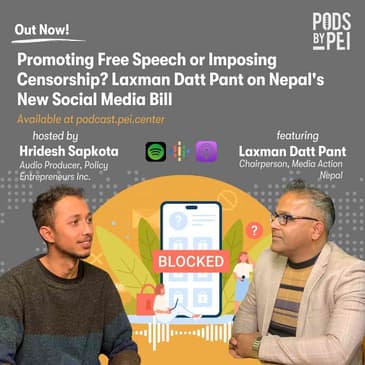
#Ep.082
Laxman Datt Pant is the chairperson of Media Action Nepal and an elected co-chair of the Media Freedom Coalition-Consultative Network (MFC-CN). He is also an adjunct Professor of Media Ethics & Journalism at the Tbilisi State University and the University of Georgia. He currently serves as the AMIC Country Representative for Nepal.
Pant started his career as a journalist more than two decades ago and worked with numerous media institutions in different capacities ranging from a reporter to an editor.
PEI’s Hridesh and Laxman delve into analyzing the bill's provisions and how they may conflict with constitutional rights to free speech. They also explore how Nepal can better foster digital spaces as forums for civic expression and debate.
If you liked the episode, hear more from us through our free newsletter services, PEI Substack: Of Policies and Politics, and click here to support us on Patreon!!
[00:00:00] Namaste and welcome to Pods by PEI, a policy discussion series brought to you by Policy
[00:00:19] Entrepreneurs Inc. I am Shriya Rana.
[00:00:22] In today's episode, we have PI colleague Videsh Sap P.I. Lakshman. We're glad to have you here to have this discussion on very important issue. Thank you, Rudesh. It's a great honor for me to join your podcast. Thank you. So today we want to delve into the recent social media bill of Nepal, 2018, exploring its implications for Federal Democratic Republic. Maybe 15, 17 years ago, we realized that. Also there are systems that are fundamentally authoritarian in reality, but sometimes countries are ruled by absolute sort of communism.
[00:03:02] So we are in a democracy, and only in South Asia, despite being democratic.
[00:05:43] So these are all discussions. this bill and why is it important? Regulation of media is required. Regulation is accepted. There are some theories, for example, censorship. As long as government or authorities are not motivated by the principle of controlling independent voice or civic space, it's fine for authorities offline are also guaranteed online. Recently, the Human Rights Council of the United Nations stated that rights that we enjoy offline in Mandalore or in the street elsewhere to show our sometimes frustration
[00:08:22] or appreciation to anything that should it a robust policy tool. Can you go over some of them? Media policy reform issue is a long discussed issue here in Nepal. If you remember, we have been long talking about
[00:09:42] coming up with an Amrela Act regulating all media platforms,
[00:10:46] If you are principally grounded in something, you will have less criticism of that thing. So that is one thing lacking.
[00:10:47] Second, a lot of policies are coming into public discussions because they lack serious
[00:10:53] sort of engagement from the experts.
[00:10:56] And third one is these policies are introduced.
[00:10:59] I remember many of Robinson assemblies in Nepal, including wanted to have collaboration with Election Commission of Nepal. We're very sort of suspicious about the work of big data companies as well. The data that preserve with them, because this bill is providing a sort of right to the social media platforms
[00:12:21] to have their own privacy policy.
[00:12:24] That means your data could be either protected as someone who has advocated for freedom of speech, could you elaborate on the bill's specific provisions that have raised concerns about freedom of speech and expression? The one important thing is it will create a very fearful society, mostly on part of those who are critical to any wrongdoings of authorities
[00:13:40] and power centers.
[00:13:41] For example, let's connect this bill
[00:13:44] to the workshop journalist information technology bill.
[00:15:02] Ministry often goes on that they are in the media, then it will be a very direct threat to democracy as well. Yeah. Yeah, that's very interesting inside Laxman. So now that we have mentioned about the user accountability side, I also want to touch
[00:16:23] up on the challenges in enforcing these I said have authoritarian political system. So yes, user accountability is very important invest upon sort of, educated, informative programs, possibly in the universities and schools. Yeah, also can you add on to the regulating body or the regulating body that the bill proposes? Also the arrangement of that body being political,
[00:19:01] can you add on that?
[00:19:03] If you look into the media councils,
[00:19:05] the social media bill that authorities could look into your intentions. How can you check my intentions? And can you check my intention, looking into my face,
[00:20:21] unless you are a psychologist?
[00:20:23] OK.
[00:20:24] You can't check it. Let's take a moment to understand the flip side of this issue. The proponents claim that the bill helps prevent the spread of disinformation. They focus on the sensitive issues of elections and call for an end to false information, propaganda on the social media. The social media space also recently nurtured populist
[00:21:40] politics in Nepal, additionally with the rise of AI defects
[00:21:44] that makes it hard to ethics, ethical standards. So if we go on educating people, if there are some sort of guidelines, and if authorities come to a conclusion
[00:23:00] that this guideline can be shared among internet users
[00:23:04] or social media platform users,
[00:23:06] then automatically there will be less disinformation saying that we should also work out on coming up with some anti-disinformation laws. What is disinformation? You don't like some interpretation or data that could be disinformation for you, but at point, there are regulatory organizations. Let universities and institutions like Press Council look into these issues, educating
[00:24:20] people that this is do's and don'ts.
[00:24:23] You can do that. about how social harmony could be measured. So in relation to that, there are many other platforms as well. So when you are coming or going through sort of more specific bills to prevent what you referring to disinformation or misinformation or misleading news, that would also be detrimental to the health of democracy.
[00:25:43] So instead of coming up with a lot of regulatory frameworks
[00:26:43] They were released yesterday on some personal guarantee, but they should appear before police
[00:26:46] if there is further clarification needed.
[00:26:48] This is not the first time that police
[00:26:51] has been using electronic transaction access clause 47.
[00:26:55] Actually, they are misusing this clause
[00:26:58] to arrest or go against independent critical voice
[00:27:01] on social media.
[00:27:02] So instead of coming up with a lot of specific regulatory
[00:27:07] mechanisms, I think we need to look back or sometimes because bills are originally generated in the concerned ministries. And they must be very much careful about our fundamental rights provisions. They should not go against that split, including that of our commitment to international community. That is one thing. Second, we should not go on comparing our context
[00:28:22] to countries like Afghanistan or Somalia or Iran
[00:28:27] or some context. month, eight months, if there is that much urgency, you should lobby with parliamentarians to come up with the law, because that must be legitimate and that must also be required by law, not only required by law, but also by that is good for the health of democracy. So these are some things I think, principally, policymakers not forget that we do have very specific, unique provisions in the Constitution. The foundation of any specific laws coming in force should base, this discussion should base upon the constitutional provisions. There are very less criticism about the fundamental rights provisions of Nepal's own Constitution
[00:31:05] in the international arena. introducing a new law, enforcing new law, I think we should not forget the principle that these laws do not exist in vacuum. There is some interrelationship of what throughout the 17 or 18 years plus after the end of monarchy we have instituted very strong foundations of law reform process. Yes, that's very interesting. So
[00:32:22] Laxman, do you think Nepal can do better on this front by focusing on digital back wanted to have sort of ban over TikTok, but due to court order, they could not do that. So I think a lot needs to be invested in infrastructure issue, but rather than infrastructure capacity of the internet or digital kind of thing, we need to invest much on awareness building.
[00:33:41] And that awareness building should come to be initiated not alongside the government do not guarantee that you are digitally safe. So that is very important for me. Yes. So we are almost at the end of this conversation. If you have anything to add onto our conversation today, or if you would like to add anything from your side. Yeah, I represent civil society organizations, bleeding a CSO here, but also working for safety
[00:36:23] of journalists and civic space globally
[00:36:25] through my engagement with global network these things rather than silencing independent and critical voice in social media platforms. That would be helpful for the health of democracy. Thank you so much, Laxman, for joining us today at Pods by PI. And it was a wonderful, insightful conversation and thank you so much for being here.
[00:37:40] Thank you very much to you, Ritesh, and to your team.
[00:37:44] And I look forward to listening to this conversation.