
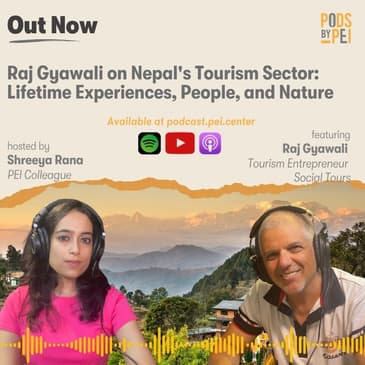
In this episode of PODS by PEI, PEI colleague Shreeya Rana sits down with Raj Gyawali, tourism entrepreneur and founder of Social Tours Pvt. Ltd., to explore how sustainable and community-based tourism can redefine Nepal’s future.
Raj shares personal stories from his two-decade journey in tourism, unpacks the value of local communities in the tourism value chain, and challenges conventional development models. From livable destinations to people-first tourism, this conversation offers deep insight into what makes Nepal’s tourism product truly unique—and what needs to change.
Topics covered:
The shift from adventure to experience-based tourism
The flower power movement and Nepal’s 1960s tourism boom
Grassroots sustainability in rural tourism
The real contribution of tourism to Nepal’s economy
Navigating climate change and over-tourism
If you care about responsible travel, Nepal’s development, or the intersection of tourism, identity, and community, this episode is a must-listen.
***
About Raj Gyawali: Raj has over two decades of experience working specifically on responsible tourism in practice – on the ground developing his company Social Tours as the first tour company in Asia to be sustainability certified.
As a consultant, he helps governments and communities develop more sustainable practices, and inserts sustainability strategies in government plans.
Raj’s work ranges from training guides in more sustainable practices, to educating customers on the practice of responsibility in tourism as travelers, developing more sustainable tourism offerings, as well as guiding governments and stakeholders in putting sustainable procedures into action.
***
If you liked the episode, hear more from us through our free newsletter services, PEI Substack: Of Policies and Politics ( https://policyentre.substack.com/welcome ), and click here ( https://patreon.com/podsbypei ) to support us on Patreon!!
[00:00:11] - [Speaker 0]
Namaste and welcome to Pods by PEI, a policy discussion podcast series brought to you by Policy Entrepreneurs Inc. I am Kushi and in today's episode, PEI colleague, Shreya Rana, is in conversation with Raj Gewali on Nepal's tourism sector, lifetime experiences, people, and nature. Raj Gyalali has over twenty years of hands on experience in responsible tourism, founding Social Tours, the first sustainability certified tour company in Asia. His work spans guide trainings, traveler education, sustainable product development, and strategic planning for tourism stakeholders. Shriya and Raj explore Nepal's tourism assets through the lens of sustainability.
[00:00:58] - [Speaker 0]
They attempt to unpack what truly defines Nepal's tourism brand and how a thriving industry can uplift local economies. They also discuss issues like overtourism and climate change, asking how can Nepal grow its tourism sector without losing what makes it special. Like listening to Pods? We'd love to hear your thoughts so please leave your comments on Spotify, Apple Podcasts, YouTube or wherever you listen to the show. You can also follow us on Twitter tweet2pei and on Facebook and Instagram policyentrepreneursinc for updates on the latest episodes.
[00:01:36] - [Speaker 0]
We hope you enjoy the conversation.
[00:01:45] - [Speaker 1]
Welcome Raj, welcome to Pods by PEI. It's such a great honor to have you here. I know it's going be a very interesting conversation. You look excited to talk about tourism.
[00:01:53] - [Speaker 2]
It's a passionate topic for me.
[00:01:55] - [Speaker 1]
So let's begin with your passion which is the tourism sector. Can you briefly take us through the journey you've had with this sector? Why did you begin? How did you begin? And what particularly interests you in this sector?
[00:02:08] - [Speaker 2]
I started my career a long time ago after doing my business degree through research and working a lot through the corporate lines. But I got fed up with the corporate side and I wanted to work in fair trade, Something to do with sustainability in a way, but being just businesses, right? After I did that and I went through that phase, and while doing that in the late '90s, I also managed to bring in a few students through my partner, a British partner, who brought his school from The UK to Nepal. And we did something called cost plus sort of trip. So they had a wonderful trip in Nepal.
[00:02:47] - [Speaker 2]
They had trekked, they rafted, they did all the things that Nepal offers, but they also added another $200 to do some charity. And using that, we connected with Tilganga and did a cataract eye camp in Sindhupal Tok. And that was, for me, probably a realization in terms of the power of tourism of actually doing good, right? And for me, that sort of triggered something in my mind. I hadn't really finished my journey through manufacturing and export, and I was exporting to H and M at that time.
[00:03:19] - [Speaker 2]
But when the bottom fell out, the whole Maoist thing happening here of the manufacturing industry, then when I had to switch, then it was an obvious switch for me. And that's where tourism came in.
[00:03:32] - [Speaker 1]
So I think all over the world Nepal is known for its adventure, it's known for its mountains, it's known for its wildlife. But from your perspective, what do you think is that true identity of a Nepali product?
[00:03:44] - [Speaker 2]
That's probably the question that we need to tackle in Nepal a lot, a lot. Even when I was doing my research in the early '90s, one of the researches that we did was an exit sort of poll of travelers leaving the airport and Trivun International Airport. And this is a saying that is popular in Nepal. People come for the mountains, but they go because of the people. And I think Nepal's biggest asset is the people, are the people.
[00:04:10] - [Speaker 2]
This unique blend of different ethnicities that we have, different beliefs, systems of different people living at different altitudes under different geographic conditions, I think that is our biggest asset actually. The rest of it is there. I mean, the mountains are not going to go away, they're only getting taller. Sometimes they'll have snow. In the next thousand years, they might not have any snow, but our biggest asset are our people.
[00:04:36] - [Speaker 2]
So for me that is the biggest thing that we have.
[00:04:39] - [Speaker 1]
So when you talk about people, there was a very big movement that was very closely connected to Nepal and I think it boosted Nepal's tourism. I don't know if you're going to put this on the episode, but I want to talk about the 60s and 70s where tourism in Nepal was for a particular reason and it had both a social and a political background to it. But it did bring a lot of tourists in Nepal. And I think you already know where I'm getting at. So what do you think about this movement where countries in the world, they're already taking this particular path boosting tourism in their countries.
[00:05:13] - [Speaker 1]
Do you think Nepal can take that path at this point?
[00:05:16] - [Speaker 2]
Yes and no. I don't know yet how that would come about. But it came to Nepal in the 60s just by pure chance. It didn't come to Nepal because Nepal had an image. The story actually runs that in the late 60s, people were gathering in Amsterdam trying to escape the drudgery of Europe of the industrial revolution.
[00:05:36] - [Speaker 2]
And these were the flower power guys, right, with their flashy shirts. And getting into what was called a magic bus and traveling all the way east. Their idea was just to go east. They didn't want to be anywhere near Europe. That was the whole idea.
[00:05:49] - [Speaker 2]
And by the time they reached Istanbul, for example, that was east enough back in the day, but they didn't find themselves far enough. And then they crossed the Bosphorus and then came over and went into Iran, which was lovely, very modern at that point in time. But again, they could not connect with the people. And then they went to Afghanistan, which was full of drugs. It was brilliant.
[00:06:12] - [Speaker 2]
Full of opium, lovely area, but very harsh. So they ventured into Pakistan and India, which are very friendly people, but a little too aggressive for their nature. And then somebody in India probably told them of this valley up in the mountains where, there was enough marijuana and the people could just enjoy themselves. And when they came here again, what they found was not the marijuana, was the people. The people who did not bother them at all, no matter what they did.
[00:06:43] - [Speaker 2]
And they just enjoyed and absorbed what they offered. And this is how we got connected to rock and roll, how the music scene started in Nepal, all came because of these guys. It's a very interesting thing how that transpired, right?
[00:06:56] - [Speaker 1]
I don't know if we're actually going to use this but I just wanted to take up
[00:06:59] - [Speaker 2]
this Not because Thailand is doing it or it's legalized in other areas. I mean it is a part of lifestyle here actually to tell you the truth. It is rooted in our culture that it was there. The Sadhus used it for meditation. We still use the seeds as part of our spices.
[00:07:15] - [Speaker 2]
It's
[00:07:16] - [Speaker 1]
useful. I just wanted to take this opportunity. I think this does have a direct impact especially on small businesses, local communities for whom this is their livelihood, this is their main source of income. So even beyond this particular product within tourism, are other products or other services within the value chain from which many communities can benefit. Can you tell us what that journey has been in terms of going to the roots and making a difference where it I actually
[00:07:43] - [Speaker 2]
mean, Nepal has got a very unique tourism product that it's known for. And a lot of it is to do with going into rural communities and meeting people. That is where, which gives it the chance for micro businesses to thrive, right? Whether it's a lodge, whether it's a small little handicraft business that is contributing into tourism or farmers putting their food into the table at a lodge. This is something that Nepal has got very unique.
[00:08:12] - [Speaker 2]
Our tourism is hardly city based. It's all rural based, right? So the number of people that get involved in tourism is very, very high here because of that, right? Because when you go into a rural area, whether you eat or whether your stuff is being carried or the stuff that is brought for the tourist or, you know, I mean everything is actually done by very small, small businesses.
[00:08:34] - [Speaker 1]
And I remember that one example that you gave of that table in a restaurant which had so many actors come into play, which had value addition at so many different stages and that's all part of the tourism sector. Tourism sector goes parallelly with economic growth. In your experience how have the two evolved? Do you really see tourism bringing economic benefits that it promised to bring in?
[00:09:00] - [Speaker 2]
I think it does. I think it does. I think statistically if you look at the government side we might not be calculating it enough because a lot of it is informal. Say, I mean, the same example as the table, I mean, does government statistics ever count the guy who manufactured the table that you're sitting on, right, at a small lodge in the mountains. And he's also related to tourism, but nobody actually calculates the labor that was put in to make that.
[00:09:29] - [Speaker 2]
That economics never makes it into the macro picture. So there are two things that are running parallel here in Nepal. One is the government looking at just the number of operators, number of hotels, number of guides, that sort of stuff, and looking at taxation as an economic figure to find out how much tourism contributes. Then there's a massive amount of other side. I cannot tell you a percentage, but there's a huge number where it's completely informal, but it's still connected to the tourism sector.
[00:10:00] - [Speaker 2]
So if we actually are able to calculate that or even estimate that, the actual contribution of tourism in this country was going to be much, much, much higher.
[00:10:09] - [Speaker 1]
So let's move towards the demand side now. We talked about the evolution in some sense. We connected it to the economy. We connected it to the communities. We connected it to how businesses are organized.
[00:10:23] - [Speaker 1]
Now we should also talk about the tourists who come in. So over the years there has been quite a shift in the kind of tourists that are coming. Maybe that is because of the products that we've been able to offer. So what are your comments on the kind of arrivals you see?
[00:10:40] - [Speaker 2]
Yeah, I think that has changed. The type of people who are coming to Nepal earlier were just pure adventurers. There is also a reason behind that. There is not a lot of information going out of this country. You got to remember that this country was closed until the 50s.
[00:10:56] - [Speaker 2]
Nobody used to come here. And then slowly information started permeating out. It's only in the 90s, post 90s, mid 90s we started hitting the internet and then information started getting much more available, right? And that has also transformed the way people travel around the world. So with information not going out from Nepal too much, Nepal was just a hard country to come to.
[00:11:18] - [Speaker 2]
It was very difficult to come to, there were very few flights. Everybody knew that people just thought that it's all about mountains, it's all about toughness when you're here, or jungles, or malaria, or whatever, right? I mean, once the information started going out and the way that there's a shift in how travelers travel nowadays with the amount of information they have, I mean, it's also a shift in the type of traveler that is coming in. So we move from slightly hardcore adventure, if you like, in terms of the type of mentality that the traveler had, to a soft adventure sort of, which is a much, much bigger, broader base in the market, right? Nepal is an amazing country where crossing the road is an adventure, right?
[00:12:03] - [Speaker 2]
You've got hardcore travelers right now in the country, they're climbing Everest, And they also are the hardcore guys who are doing some really crazy mountain bike rides, some crazy motorcycle rides and stuff like that. But there's a huge amount of people who are just doing soft adventure. Now, you look at the official figures, which I don't agree with, we are taking about a 1,200,000 tourists, right? On a good year, we have done 1,200,000 tourists. And out of 1,200,000 tourists, about 350,000 are trekkers.
[00:12:34] - [Speaker 2]
So the majority is not trekking. The majority is just people wandering around, you know, they go to, you know, just and their adventure is probably food. Their adventure is probably just crossing a street. Their adventure is, you know, just doing a bus ride here, you know, That is the level of adventure. So we are an adventure destination.
[00:12:52] - [Speaker 2]
There is no doubt about it. Everything that we do here is about adventure. Even when you are experimenting with our philosophy, it is an adventure. So everything is adventure in this country. But the type of traveler that is taking an adventure has changed.
[00:13:06] - [Speaker 2]
It's also true that globally, there are more people gravitating towards adventure as a holiday, you know? So whether it's a soft adventure or a hardcore adventure. We are also moving in that direction. So yes, the type of people coming in have changed.
[00:13:24] - [Speaker 1]
Moving from international tourists, there's a big segment of domestic tourism. Synonymous to Pokhara or Chitwan, but these are very limited itineraries. In your perfect tourism itinerary within Nepal, how would you design that particular itinerary so that somebody who comes to Nepal experiences the whole of Nepal?
[00:13:43] - [Speaker 2]
It's very difficult because Nepal is full of amazing pockets of experiences, right? I mean, you can go in the base of Dholagiri to a blacksmith village, for example, and experience just their community, for example. Or you can go to the, you know, in a remote village in Dolpo and look at the tradition from, you know, Tibetan descent from a completely different perspective. You can do pilgrimages that go up to Mount Kailash on the Western side of Nepal too, just looking at the big mountains on the Eastern side. So we've got this depth that we have, which is incredible out here.
[00:14:20] - [Speaker 2]
So one itinerary will probably never encompass what Nepal has to offer. But it's probably a network of smaller journeys, which go from looking at communities, to looking at food, to looking at nature, to looking at wildlife, all of that. I mean, we are incredibly blessed with all these things here. And I think if we create this sort of a little network of journeys that will actually showcase the whole country, it will actually allow us to do multiple journeys in Nepal even as a domestic traveler or as an international traveler, which means more for the economy anyways. But if you do just one journey, I mean, just walking from the East to West of Nepal is one hundred and fifty days.
[00:15:04] - [Speaker 2]
Not a lot of people have that sort of time to actually just, that's just one journey across and you can do that multiple levels in Nepal. So, I think it's different journeys coming together, which actually showcases Nepal.
[00:15:16] - [Speaker 1]
Yes. And definitely because we are so blessed, we have so many.
[00:15:20] - [Speaker 0]
Hi there. This is Kushi from Policy Entrepreneurs Inc. We hope you're enjoying Pods by PEI. As you know, creating this show takes a lot of time and resources, and we rely on the support of our community to keep things going. If you've been enjoying the show and would like
[00:15:35] - [Speaker 1]
to help us out, we'd really appreciate it if you could become a patron on Patreon.
[00:15:41] - [Speaker 0]
Patreon is a platform that allows listeners like you to support creators like us with a small monthly donation. Your support will go a long way in helping us to continue creating high quality content for you. So if you're interested in supporting our show and becoming a
[00:15:56] - [Speaker 1]
part of our community, head on over to Patreon and become a patron today.
[00:16:01] - [Speaker 0]
You can find us at patreon.compodsbypen. Every little bit helps, and we can't thank you enough for your support. Now let's get back to the episode.
[00:16:15] - [Speaker 1]
Yes. And definitely because we are so blessed, we have many people coming into the country. But one of the biggest challenges that Nepal has is in terms of earnings from the tourists that actually come into the country. Nepal is situated at the bottom when it comes to tourist earnings in South Asia. That's a big problem.
[00:16:34] - [Speaker 1]
This is where we need to talk about overtourism and where we'd bring in the sustainability angle would be at this juncture. So can you tell us more about what the sustainability angle is?
[00:16:45] - [Speaker 2]
Yeah, I think sometimes we compare sustainability with how much money is made. Actually, that is sometimes a little bit off. You can have very sustainable, low budget travelers. You can have very low budget sustainable travel and you can have very high level unsustainable travel as well. So it is about actually how you practice it, right, when you see it.
[00:17:11] - [Speaker 2]
Nepal statistics right now, I think is currently at $42 per day or something like that, is abysmal. But I actually again do not agree with the statistics because the cost of actually doing tourism in Nepal is far higher than just $40 But I think there is a bloated arrival figure which actually contributes to that because that's where you divide it by. So when you divide it by bloated number, you're going to get a smaller figure. And I think that is where the problem is. But let's not talk about the money.
[00:17:45] - [Speaker 2]
What is important is how the tourism is done. In how the tourism is done, there is a lot of sustainability inherent in Nepal. One of the key aspects of sustainability in tourism is how the money is distributed And because we go into rural areas and we go into multiple villages in most of our itineraries in Nepal, the money already gets distributed in a certain way. And it gets distributed to vehicles, gets distributed to lodges, it gets distributed, you know, it eventually does go around. But how much of that goes?
[00:18:17] - [Speaker 2]
Does it go on time? Is it the right amount? Those things are the sustainability issues that we need to look at. But there is an inherent mechanism of sustainability that's already here. We just have to look at the quality of sustainability that is actually happening.
[00:18:31] - [Speaker 2]
Interestingly, almost every operator who's got a business that is probably registered in Nepal does charity. It's amazing. The Nepalese have got this amazing gift of doing charity, also because they're still connected to their villages. So they eventually go back and sponsor a child or do something in the school or something or the other is always happening. So there is a little giving back that is already inherently there.
[00:18:58] - [Speaker 2]
How much do they do that? How much do they think when they do that? Is it deep sustainability or is surface? Is it greenwashing? Is not.
[00:19:05] - [Speaker 2]
I mean, those things we can debate, right? But what I'm trying to say is that this is a perfect country to actually do that because it's already there. You look at tourism, it's a very flat structure. If you go to Europe, three companies control 80% of the business. It doesn't happen here.
[00:19:24] - [Speaker 2]
It doesn't happen here. Here, it is all flat. Everybody is competing with each other, but it's all very flattish structure. There are some big companies. They probably take care of 10,000 travelers out of the 1.2, but they're not taking care of 800,000 travelers.
[00:19:39] - [Speaker 2]
So that is a very interesting thing that is there in Nepal. But how we do the sustainability, we have a lot
[00:19:45] - [Speaker 1]
of work to do. A lot of work to do. It's for each country to decide how they want to chart their tourism journey, sustainable tourism journey. The global sustainable tourism council that promotes livable destinations. Could you tell us more about what livable destinations, what it means for Nepal especially?
[00:20:02] - [Speaker 2]
Livable destination is probably the latest in terms of buzz words right now but it probably encompasses the best thing that can happen to a destination when travelers come in is to actually make the place so happy that the residents of that place do not want to leave it. And this is also a very strong concept in tourism destination development because some of the best destinations in the world are places where the inhabitants are really happy. So if you look at the world, I'll go into Dipal a little later, but if you look at the world right now, you have a few destinations in Scandinavia for example or in Latin America for example, where the tourism is very matched with the destination. It's not overly done. The destination has got conservation issues that they have tackled.
[00:20:57] - [Speaker 2]
Culturally conservation is also tackled. The residents are happy because everything works in their destination. And if you ask any individual citizen in that place and say, would you ever leave this place? They will say, no, I will never leave this place. And then we have destinations like New York or we have Barcelona or you have got Amsterdam where the residents are pulling their hair out because there's over tourism going on.
[00:21:20] - [Speaker 2]
And then you have big movements saying tourists go back, you you have all that thing. That is not a livable destination. That is not a destination where people are really happy because tourism is there. Now in the context of Nepal, I had a meeting with some people. I was actually asking them if there's one place in Nepal where they would say I would never leave this place.
[00:21:41] - [Speaker 2]
Funnily enough, nobody had an answer to that. And that's a very sad situation to have. When we always continuously say, heaven is a myth, Nepal is real. We've got all these beautiful terms. But then interestingly, recently I also heard from some other speaker about a very interesting sort of story where back in the day in the thirteenth century when Kathmandu was just going up during the Malla, Malla Kal, they had just brought in water supply from the hills to the city so that everybody could have drinking water.
[00:22:18] - [Speaker 2]
The kings had the same drinking water as the people in the city. You know, architecture was great, the temples looked beautiful. At that point in time, if the king told one guy in Kathmandu, please leave this valley, he would beg for mercy. He would say, I would never want to leave this valley. It has got everything that I need.
[00:22:43] - [Speaker 2]
And this is what we want back. That is a livable destination.
[00:22:48] - [Speaker 1]
Now I'm going to ask you the difficult question. How do you reach there?
[00:22:54] - [Speaker 2]
It's not rocket science. This is the thing. I mean, we think these things are difficult, but it's not. Strategically, it would mean we'd have to have a very deep listen to the people. We'd actually have to take care of the people's basic needs first so that the people are really, really happy.
[00:23:11] - [Speaker 2]
And then use tourism as a vehicle to make that happen. So for Nepal, I think the key shift that we require is moving from power centricism that we have cultivated over centuries of just looking at the power and deciding everything is decided from the power center to being people centric. And if you start just turning that around, it's not that we don't have the mechanism, we have done it before. So it's just about turning it around. If we start becoming people centric and listening to the people and trying to find out what they actually need and creating a mechanism around that, we can actually turn it into actually livable destinations.
[00:23:53] - [Speaker 2]
One place at a time, obviously. Things are changing in this country. There's no doubt about it. Pretty much like what used to happen during the Mala times when the kings, because they were brothers or relatives or whatever, fought over each other over food. Who makes the best Eilau, who makes the best Choilau, or who makes the best temples or who makes the best water supply.
[00:24:18] - [Speaker 2]
We have the mayors fighting right now over the same things. So Balan thinks Kathmandu is better, Chiribaba thinks Lalitpur is better and they keep on fighting. And that is exactly what we need. That sort of competition really creates livable cities. And that is where the difference starts coming in.
[00:24:36] - [Speaker 2]
And then, of course, really looking at people's needs, like pollution, for example, which we faced a few weeks ago. If nobody is listening, then we'll not find any solutions. But if people start listening to the people and then doing things, then people will say, I'm hurt. I don't want to go somewhere else where I'm not hurt. So it's not rocket science.
[00:24:55] - [Speaker 2]
We can reach there.
[00:24:56] - [Speaker 1]
You just talked about something very important air pollution. Climate change and its impacts are definitely real, especially for a country like Nepal that is completely reliant on its peaks for its top earning tourists. The current scenario does not look too promising. Are we losing out on our major product? How do you see it?
[00:25:16] - [Speaker 1]
How do we make sure that we don't lose out an asset and over something that we don't have much control?
[00:25:23] - [Speaker 2]
Climate change is something I think is critical for Nepal tourism or just for living as well because we are reliant on the water that comes from the mountains. But at the same time, it is something that is bigger than just us. We have a role to play, no doubts. I mean, even the pollution, we have a role to play, but it's not just us. There are others involved as well.
[00:25:48] - [Speaker 1]
But do you think these trends are also impacting the kind of tourists that are coming over the years?
[00:25:55] - [Speaker 2]
Yeah, it is. I mean, it will impact. I mean, yesterday we had a death in Ahmedabalam and that was because of the lack of snow. So somebody fell to his death because now it's more rock climbing than actually mountaineering. And I think that sort of situations are starting to happen.
[00:26:12] - [Speaker 2]
So it will impact tourism, there's no doubt about it. Having said that, tourism is also very resilient. You've got to remember that tourism has never not grown in the world. It's a crazy thing. I mean, you'd say why?
[00:26:28] - [Speaker 2]
I know the answer why because tourism came from being a luxury before of something only the rich could afford to becoming something that a vast majority could afford and now from becoming a luxury it has become a necessity for people. And when that is happening, it is just growing all the time. So tourism is resilient. It doesn't matter what happens, people will come. You've got tourists going to Dubai which has no water.
[00:26:55] - [Speaker 2]
You see what I mean? Things will still happen, but the type of tourism will change. There's no doubt about it. But we do have a role to play. Each one of us have a role to play.
[00:27:08] - [Speaker 2]
We need to be very conscious about it. It's not just us. Even if 30,000,000 people that we have in Nepal do all the right things, we'll still have pollution. We'll still have the snow melting. There's no doubt about it.
[00:27:22] - [Speaker 2]
But we have a global role to play as well in terms of making more sound about it because we are, I think, the eighth country affected by climate change in the world.
[00:27:32] - [Speaker 1]
I think where that should take us is look at alternatives because as a country we cannot only be relying on the mountains to bring in the high paying tourists, right? We need to diversify our product. We need to look at other things that we can develop and position. Do you see that happening? Are people even ready?
[00:27:51] - [Speaker 1]
Is Nepal really ready to host so many people? Because we keep announcing it's tourism year, it's tourism decade. But are we ready to host that many people?
[00:27:58] - [Speaker 2]
The word many is important. We don't need many. We need quality, that's more important. We already have the assets for it. So the mountains are what has made us famous, but the good memories of Nepal usually stay because of the people.
[00:28:18] - [Speaker 2]
So let's not forget that. So working on our assets as people, as resilient, warm hearted, friendly, smiling, hospitable people, and looking really deep into ourselves and seeing what our assets are and trying to retain that is going to be probably the best way to actually preserve tourism in this country. Like I said, that is in our control. The mountains, the snow going sometimes is not in our control. The pollution coming in and out sometimes is not in our control.
[00:28:46] - [Speaker 2]
Sometimes it is, sometimes it isn't. But what we can definitely preserve is our way of life the way we are. And I think that is the reason why the first tourist came here. That's the reason why people still go back here from here and have that sort of memories about Nepal. But I fear that we don't value it enough.
[00:29:07] - [Speaker 2]
And I think that is where we really need to make an effort.
[00:29:10] - [Speaker 1]
So going back to the first question, what is our major problem?
[00:29:14] - [Speaker 2]
Our people. Our people and our lifestyle. That is the only thing that is sustainable because that we can actually work on.
[00:29:22] - [Speaker 1]
Thank you Raj, that's my question. We ended on a good note on people. I think that will resonate with a lot of our audiences. This was really fun Raj.
[00:29:31] - [Speaker 2]
Thank you.
[00:29:31] - [Speaker 1]
Thank you so much for sharing your insights. Thank you for answering questions that were also difficult. I tried to put in a few surprises there, but thank you for taking them graciously. At all. Thank you so much.
[00:29:44] - [Speaker 1]
And that's a wrap.
[00:29:45] - [Speaker 2]
Thanks so much. Thank you.
[00:29:49] - [Speaker 0]
Thanks for listening to Pods by PEI. I hope you enjoyed Shriya's conversation with Raj on Nepal's tourism sector, lifetime experiences, people, and nature. Today's episode was produced by Nirjhun Rai with support from me, Kushi Hang. This episode was recorded at PEI Studio and was edited by Nirjhun Rai. Our theme music is courtesy of Road Shakya from Zindabad.
[00:30:16] - [Speaker 0]
If you like today's episode, please subscribe to our podcast. Also, do us a favor by sharing us on social media and leaving a review on Spotify, Apple Podcasts, YouTube, or wherever you listen to the show. For PEI's video related content, please search for policy entrepreneurs on YouTube. To catch the latest from us on Nepal's policy and politics, please follow us on Twitter at tweet to PEI. That's T W E E T followed by the number two and PEI.
[00:30:48] - [Speaker 0]
And on Facebook at Policy Entrepreneurs Inc. You can also visit pei.center to learn more about us. Thanks once again from me Kushi. We will see you soon in our next episode.