
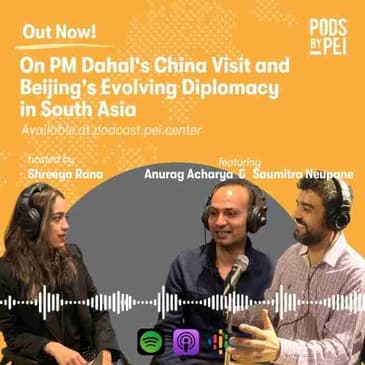
#Ep.066
This episode was recorded as a special episode prior to PM Dahal’s official visit to China.
In this special release, PEI colleagues Saumitra and Anurag are joining Shreeya to discuss the evolving Nepal-China relationship amidst a rapidly changing geopolitical landscape.
Saumitra is the Executive director at PEI. He leads projects on infrastructure, bilateral investments, and aid. He has been an integral part of key reforms in Nepal’s electricity sector and contributed to numerous researches on cross-border electricity trade and transboundary water resources.
Anurag is the Director of Practice, he leads PEI in thematic areas of governance, politics, and foreign aid. Anurag is a well-known political commentator and has written extensively on Nepal and South Asia, for national and international publications.
[00:00:14] - [Speaker 0]
Namaste and welcome to Pods by PEI, a policy discussion series brought to you by Policy Entrepreneurs Inc. My name is Sonia Jimmy. This episode was recorded as a special episode prior to PM Dahal's official visit to China. In this special release, we have PEI colleagues, Somithra and Anurag joining Shreya to discuss the evolving Nepal China relationship amidst a rapidly changing geopolitical landscape. Somatra is the Executive Director at PEI where he leads projects on infrastructure, bilateral investments, aid and has been an integral part of key reforms in Nepal's electricity sector and contributed to numerous researches on cross border electricity trade and transboundary water resources.
[00:01:03] - [Speaker 0]
Anurag is the Director of Practice. He leads PEI on thematic areas of governance, politics, and foreign aid. Anurag is a well known political commentator and has written extensively on Nepal and South Asia for national and international publications. We hope you enjoy the conversation.
[00:01:27] - [Speaker 1]
So I'm going to begin today's episode with you, Anurag. As you know, PM Dahal's visit to China has been a matter of speculation for some time, and it's finally happening now. Given the domestic political dynamic in Nepal where prime minister Dahal had to navigate through complex political terrain, and also in this evolving regional context, what could have been the reason behind this delay?
[00:01:49] - [Speaker 2]
Well, to begin with, the delay could be for a number of reasons. For one, it could be lack of preparations on both sides. But last few months have also seen several important events like BRIC Summit in Johannesburg and India's G20 event. So you can expect the Chinese side to be quite busy with preparing for these events and also the timing of the visit in the shadows of these events would not have been good for Nepal. So the mileage that it needs from this visit probably prompted even Nepal to propose the visit after those events.
[00:02:27] - [Speaker 2]
And talking about the context of the visit, The domestic context on both sides is very interesting at the moment. Prime Minister Dahal himself is walking a very thin line with relationship between New Delhi and Kathmandu improving lately and leading to encouraging developments, especially on energy trade and not just with India, but also through India with Bangladesh, which is looking more likely now. Dahl will want to keep these developments on track on the southern front, and for Chinese side, I think they will also be very aware of Dahl's role in the split of Unified Communist Party, the NCP, which Beijing had openly supported back in 2017. So I would actually expect Xi to express his disappointment over that lost opportunity, maybe not in as many words, but nevertheless. And also, DAL's warming ties with New Delhi will also make Beijing more uptight in its dealings with Nepali delegation.
[00:03:32] - [Speaker 1]
Those are all possible explanations for the delay. And now considering China's own economic challenges, Sumitra, do you believe that the Chinese side is actually interested to proactively engage with the Nepali side, or do you perceive this visit as something to just get over with?
[00:03:48] - [Speaker 3]
Now this is a interesting question, Trey, and I think it's important to understand what's happening in China. I think there is a lot of conversation globally and in the region about China's slowing economic growth. And just to put this into context, if you are to make observations on what has happened daily around China's economy. So for for over a time, China's economic growth and progress have been the key factors driving its global ambitions. And today, people think to believe that China is reeling through its worst economic crisis post the Cultural Revolution.
[00:04:28] - [Speaker 3]
So just to put this into context, so there have been several global sanctions, most notably by The US And the global recession, which is kind of tapering demand at global demand centers, is leading to is one of the factors contributing to this. One of the major factors for China's economic slowdown would be its housing market, which is around 30% of its GDP. As people commonly know, there is a lot of local government debt in China, and local governments are central to how the housing markets operate. There are there are several figures that go around in the market, but one says that China has more than 23,000,000 unsold apartments, enough to house the entire population in The UK. Besides this, there are several regulatory crackdowns on private enterprises in China.
[00:05:23] - [Speaker 3]
We all know what happened with Alibaba, but there are several other firms. And this is really a challenge for the private sector and the trust the private sector has on on the policy stability and the economy. So private sector as drivers of economic growth in China are more skeptical than they were previously. There is rising unemployment. The last figure that the Chinese government released suggested that almost 21% of unemployment rate in China.
[00:05:53] - [Speaker 3]
It's pretty steep. And the fact that they've stopped publishing those numbers suggest that these numbers could be actually much higher. And on the external front, so as we all know, we'll come to this probably. China has lent to a lot of countries through several initiatives, most notably the Belt and Road Initiative, But a lot of these investments are currently standing in countries that are in debt crisis. There are numbers suggesting that China has, in the recent years, kind of renegotiated debts around 78 to 80,000,000,000 worth in some of these countries.
[00:06:30] - [Speaker 3]
So these challenges collectively surmount to a significant issue at the domestic front as well as the external front. These are serious problems, both back at home and externally. And from China's perspective, I don't think its current relation and interest in Nepal weighs enough to attribute to where it stands at the domestic front and externally. So I don't think there is that significant interest to engage with Nepal to significantly change any status quo. So this visit, I would presume, would be something that China would look to, in some sense, get over with.
[00:07:14] - [Speaker 3]
But having said that, one thing very notable of how Chinese engage, in the region and with countries like Nepal is they can make promises, but, they are not necessarily followed up. So you might expect something, out of the ordinary, but that would not suggest that, the relation or status quo has significantly improved.
[00:07:37] - [Speaker 1]
So that is definitely a very uncommon view of China's role in the region and particularly with the interest of Nepal's Prime Minister's visit. There are also some observers who tend to vehemently discount China's historical presence and engagement in the region, which in effect impacts the perception of China's current actions. Now coming to you Anurag, in this context, how do you assess China in the region?
[00:08:02] - [Speaker 2]
Well, I think to begin with, it's quite a fair observation, Sria, and and a part of it comes from, insufficient understanding among the section of, South Asia observers, globally regarding China's historical relationship with, countries on this side of the Himalayas, whether it is Nepal, whether it is, Bhutan, or even parts of India. To be able to understand this, we have to also be willing to put aside, geopolitics and look at the long history of trade, travel, and kinship, in the Himalayan region. The travel by monks or herders looking for pasture land or people of other walks of life crossing the Himalayan Barrier for centuries have all contributed to robust exchanges of culture, knowledge and kinship. If you travel from Pakistan controlled Gilgit region towards east through India's Ladakh, Nepal's Himalayan districts all the way to Bhutan and India's Arunachal region. There are a lot of similarities among local culture, architecture, their cuisines and also shared kinship, especially with the adjacent Tibetan region.
[00:09:10] - [Speaker 2]
Similarly, if you talk about, trans Himalayan trade of the ancient and, medieval times, they might not exist, at that level, but, markets, in the bordering, Himalayan region are still intact in many places, where geopolitical sensitivities are a bit relaxed, particularly if you look at, Nepal's mountain districts like Humla, Mustang, Manang, Raswat, Taplejung, and Teratum, all have a robust, cross border movement of goods and people. From, you know, Limi Valley in Western Nepal's Humla to Olang Chungwala of Tap Lejung in the Far East. People still rely on nearby Chinese markets, especially during the winters when snow makes traveling difficult for people in the remote areas. Now, unfortunately, many observers do not take these factors into account while talking about China's history in this region and are narrowly focused on relationship between political administration in Beijing with South Asian governments, especially this is the case after the Cold War.
[00:10:12] - [Speaker 1]
There will definitely be many perceptions with each one to judge the merit of their own arguments. Samitra, building on this, how does the tendency to overlook China's historical engagement affect our current understanding of their economic diplomacy in South Asia?
[00:10:27] - [Speaker 3]
I would just begin from where Anurag left here. So this this view of discounting China in the region, I would say that is mostly a Western, but India centric view of South Asia for the twenty first century. But, interestingly, if if you were to see the geography of the region, China borders five countries in South Asia. I mean, no country can physically border with Sri Lanka and Maldives being island nations. So besides Bangladesh, China borders all of the countries, Nepal, Afghanistan, Pakistan, India, and Bhutan.
[00:11:02] - [Speaker 3]
So you cannot take geography out out of the equation. And because of this geography, as Anurag pointed out, the proximity have had all sorts of relations dating back ages on the social front, economic front, cultural, and political. There have been many books and artifacts and oral history that have kind of translated and defined these relationships. I do not want to go there. But, principally, if you were to kind of capture this, as part of preparing for this episode, I was looking at how far this history dated back, and I picked up on a few nuances from two countries, specifically Nepal and Sri Lanka.
[00:11:39] - [Speaker 3]
And this I found to be very interesting in in the sense that Nepal physically bordering China and had a very long and ancient history. And Sri Lanka as well, though not bordering China, their history was dated back quite far back. So both have documented history of engagements from the fourth to the fifth century. In the modern times, China's relation in the region were formalized in the mid twentieth century with across all of these countries in the region. But even in this instance, you can find early notions of how China in engaged with these partner countries on the trade and economic front.
[00:12:20] - [Speaker 3]
For example, in 1950, in Sri Lanka, the Chinese relation and agreement with Sri Lanka was there was something called as a rubber and rice barter between Sri Lanka and China. So the barter essentially captured this trade arrangement where China would get rubber from Sri Lanka and provide rice to Sri Lanka. So this is a unique arrangement. It's not that, China came into the region as has been in the region off late, but there has been a long history of economic integration in the region. Well, you could say that the Chinese diplomacy in the twenty first century is somewhat different from from the twentieth, but China was never absent in the early years of the twentieth century as well.
[00:13:04] - [Speaker 3]
In fact, for many countries, including Nepal, this level of integration of society, culture, and economy provided a way to kind of manage the hegemonic dominance of India in the region. We all know, as nations, in South Asia, India is the hegemon, and there is a level of distrust among South Asians with India. So China was was that leverage that enabled countries to better engage with India. For good or worse, this has taken different turns. But, yeah, it it definitely had been something that, most countries have used and are looking to use into the future.
[00:13:44] - [Speaker 3]
So this fact of China being not a new entrant is integral to understanding South Asia and is very important to understanding how countries in the region in the future will engage with China moving forward.
[00:13:58] - [Speaker 1]
Very interesting, Samitra. Anurag, as Samitra just explained, China's economic diplomacy in South Asia has been more robust than often acknowledged. But what about their traditional agendas? Do you reckon that they've lost relevance in this evolving landscape?
[00:14:15] - [Speaker 2]
Well, when you say China's traditional agendas in this region, we are now talking about not a long period in history that I discussed in my earlier comment, but we are essentially focused on a period between 1950 and 2010 when People's Republic Of China was not a global power. Well, at least not in a way it has become over the last decade. Back then, I feel China's primary motivation and interest in the region was just to seek recognition for the annexation of Tibet and its competition over legitimacy with Republic Of China that we now call Taiwan. So in the international relations for a government that has made, you know, any kind of unilateral territorial changes or claims through the use of force or authority. Legitimacy only comes with recognition and the recognition by immediate neighborhood is considered the most important.
[00:15:10] - [Speaker 2]
So it was not unusual for China to make those efforts it did back then in seeking recognition and validation from its neighbors. Clearly it is now quite satisfied with almost all countries in the region accepting a quote unquote one China policy, and hence it makes sense for Beijing to prioritize economic and other facets of its diplomacy. Hence the focus on building soft power or focus on aid and investments is quite natural. But mind you, all these efforts are still consistent to achieving and consolidating its core political interests, including the One China policy.
[00:15:49] - [Speaker 1]
So moving on from China's historical role, let's discuss its current position under Xi Jinping. So there's no argument that China has become an economic powerhouse. It has significant implications for its neighboring countries in the region. So economic diplomacy is central to China's foreign policy globally today, and South Asia is a prime example of that. Swamitra, how has this economic strength percolated to meet the infrastructure needs and development in the region?
[00:16:18] - [Speaker 3]
I think this is where the relationship with China has been more tractable, not just for South Asia, but for much of the developing world where China is currently engaging. So if you were to see the history of development cooperation, so once post Cold War, the Western liberal order was kind of institutionalized. So much of the aid that followed from the Western development partners went into institutionalizing democracy and promoting the Western liberal democratic order. What you observed in some of these countries was that that form of aid went into building institutions, promoting human rights, democracy, and all of those. And progressively, you had less aid falling into core infrastructure work that that kind of underpins the ability of countries to actually move forward in their economic growth agenda.
[00:17:17] - [Speaker 3]
So the China's pitch essentially to to the developing world was this idea of a new development model that was different from the West in the sense that they were funding the interest of of the recipient countries to to meet their needs for economic growth. And much of that need comes or is kind of attributed to financing infrastructure, and this is where China had a strategic move and was able to kind of gain traction in their effort. But what you can observe in how this is moved forward is that countries are more willing to engage with China. Hence, I think a large number of countries did essentially subscribe to China's, you could say, the flagship economic agenda, the the Belt and Road Initiative, post 02/2013. I think there are around 150 plus countries that have agreed or signed one or the other form of arrangement related to PRI.
[00:18:23] - [Speaker 3]
There are four countries in Asia that are not members to to the PRI pact, and this include India and Bhutan, Japan, and Israel. So beyond these four countries, all of the other countries in Asia have kind of been part of the BRI initiative. So for countries in South Asia, this is a interesting position because South Asia traditionally has been underdeveloped or, you would say, a developing economy. And while the population has grown, while there is an increase in capacity, the aspirations for economic growth really hinged on the ability of these states to support through means of infrastructure development. And the tightening of fiscal space, the availability of funds, internal revenues to mobilize towards infrastructure was quite limited.
[00:19:13] - [Speaker 3]
So in that sense, BRI became a tool, or the Chinese aid, you could probably call that, became a tool for these countries to meet their infrastructure needs. So in that phase of 02/2013, if you were to look at the number of infrastructure initiatives in the region, then it's quite significant. There have been some controversies around this, but broadly, I would say that the countries in South Asia have had a good leverage to negotiate with China, and then that has translated to a number of infrastructure developments in in these countries.
[00:19:55] - [Speaker 4]
Namaste, dear listeners. This is Ridesh Sapkota from Policy Entrepreneurs Inc. We're absolutely thrilled to announce that PodsbyPI is celebrating its first year anniversary. We extend our heartfelt gratitude to all our participants and supporters who have been instrumental in making this journey a success. Your contributions have been invaluable in promoting insightful conversations and meaningful policy discussions.
[00:20:20] - [Speaker 4]
Thank you for being part of this incredible journey. But wait, there's more. We are not stopping here. We are gearing up for year two with a whole lineup of exciting topics that are sure to spark even more insightful conversations and discussions. Again, thank you for being part of Pulseway PI community.
[00:20:40] - [Speaker 4]
Now, let's get back to the episode.
[00:20:48] - [Speaker 1]
Now let's talk about China's soft power. So Anurag Andrishi, China has also invested heavily in advancing its soft power diplomacy in the region through various means. In your opinion, do you think this approach has worked for China to advance its influence in the region?
[00:21:03] - [Speaker 2]
I think China has definitely focused on building its soft power globally, and South Asia is not insulated to that effort. The reasons are fairly commonsensical. It's twenty first century, and global economic interdependence and trade interests are making it more and more difficult for large powers to assert themselves by force for obvious fears of market disruptions. And that can harm their interests as well just as it harms others. But also the expanse of media landscape globally, including the social media, has also made it very difficult for powerful states to enforce themselves and then get away with it without any kind of blowback.
[00:21:50] - [Speaker 2]
So these were the traditional tools that powerful countries used against smaller powers into aligning along their interests. But then there are reputational risk and bigger powers are now averse to using these kind of force. So instead they will be focusing more on the softer side. We know when India used sanctions against Nepal in 1980s, it wasn't frowned upon that much. But when it did it once again in 02/2015, there was a lot of criticism, not just in Nepal, globally.
[00:22:19] - [Speaker 2]
And clearly, New Delhi regrets it at some level. If you look at Russia, it still occupies parts of Georgia and Ukraine's territory, but then it lacks any kind of international legitimacy and recognition for it. So that's what the media does. So ideally, big power would, resort to using more softer diplomatic approaches, to influencing the host governments through persuasions like aid and investment support or by building a strong goodwill, among the host population and as well as institutions. Now, over the past few years, our own research has been focused on studying these approaches through aid and investment diplomacy as well as soft power tools used by China in South Asia region.
[00:23:08] - [Speaker 2]
On aid and investments, we see China's footprint in South Asia grow significantly after the year 2007 from a mere few million dollars to reaching as much as $30,000,000,000 in 2010. This was when the diplomatic ties with India were fairly normal or improving, but as those ties gradually became a strain, now it has come down to around 10,000,000,000, but then that's not all. China has also employed other charm offensive like providing generous scholarship quotas to students, professionals and government officials from various South Asian countries. It has also established Confucius Institutes, encouraged Chinese businesses, including the tech and tourism focused businesses to invest in South Asian countries like Nepal, Bangladesh, and Sri Lanka to strengthen its cultural and civilizational ties.
[00:24:02] - [Speaker 1]
Okay. So you mentioned BRI earlier, Sumithra, so maybe we spend a little more time to discuss some of the issues surrounding it. And I think the first and the most common is the concept itself. There are differences in how various individuals understand the concept. And on top of that, there are new initiatives such as the GSI, GDI floating around.
[00:24:24] - [Speaker 1]
How do you make sense of such initiatives? And do you think that Nepal can still benefit from them?
[00:24:30] - [Speaker 3]
Well, I'll tackle the last question first, and my answer would be yes and a no. We all know the Kathmandu polity is quite divided on PRI and its actual definition. So there are people who would say that we signed on to the BRI pact in 02/2017, and anything that is within that ambit of BRI MOE with China is only BRI. Anything else is not BRI. But then you have the Chinese ambassador in the inauguration of the Pokhara Regional International Airport, which claimed that this is also part of the BRI support.
[00:25:04] - [Speaker 3]
So from the Chinese perspective, BRI was a flagship initiative from 02/1314. So whatever it did on the front of economic integration and support to to the developing countries and others was part of that BRI agenda. Whether we like it or not, China's flagship initiative is the BRI, and whatever support it has been giving externally is all part of, the PRI initiative. Whether and when countries signed up to this particular pact and what that translates is to the interpretation of the country itself. But from a Chinese perspective, I would strongly believe that anything that that China supports and extends to recipient nations on infrastructure or otherwise is is BRI.
[00:25:49] - [Speaker 3]
The other issue that I commonly observe in Nepal is that the the idea of BRI often is also discussed within the scope of military engagements and otherwise. I don't think it's risen to the height of the MCC debacle where people associate signing BRI to the idea of the presence of Chinese military in Nepal. But there are number of facets like the Indo Pacific strategy. BRI is a broad strategy of the Chinese government and includes various forms of engagement and support. For example, there could be some pacts with certain countries where the idea of BRI extends to financing infrastructure projects, whereas for other countries, this could be building digital platforms for a different level of integration.
[00:26:37] - [Speaker 3]
There is increasingly this talk about digital BRI, So it's about how countries are connected in the digital space. That's where we are heading as a global economy. So that idea of BRI is for people to interpret, but whatever we interpret does not necessarily reflect what is the central Chinese view of BRI. On this notion, I think whether Nepal has kind of lost the opportunity, and I said yes or no, is that so there've been a lot of lofty promises over the years if you were to look at Chinese investments through PRI or otherwise, but generally Chinese investments, both public and private. I was reading somewhere that China is yet to fulfill around 100,000,000,000 Nepali rupees of promised funds to Nepal from 02/2008.
[00:27:26] - [Speaker 3]
So from 2008 onwards, they they promised several rounds of funding for different initiatives, including rural deconstruction and post arctic reconstruction. And of those that were committed, almost 100,000,000,000 of Nepali rupees has not been realized. If you were to look at the FDI space, you see a larger footprint of the Chinese private sector and enterprises wanting to come and invest in Nepal. But there also, you see similar trends where there are promises and commitments, but not all of them are realized. So all of this is to be taken with a pinch of salt.
[00:28:01] - [Speaker 3]
So you could be hearing and reading about big initiatives, large sums, but when the rubber meets the road, it's we often see that not all of them have been realized or have gained traction in in investments. While this, in some sense, could kind of be attributed to the challenges within the economies of of financing countries, including China, where they're not being able to fulfill promises, but also is reflective of Nepal's own capacity to absorb these funds. And that was the no part in the sense that our our trends with China of how much funds are committed and how much we realize is not just with China. If you were to look across development partners' commitments and the funds realized, you would see that there is a big gap. So it's not just China, and it's across much of the developing partners' commitment in Nepal.
[00:28:57] - [Speaker 3]
So this is also indicative of the fact that there is some systemic challenges within the Nepali economy and the Nepali policy and the Nepali practice to observe these funds. And the prime case is is then again the BRI negotiation itself. So if you were to go and track down what happened during the BRI negotiations so there was this conversation about Nepal finally signing up to BRI and the Chinese government saying, give us a list of projects. And Nepal government had put forward, I think, 30 odd projects to the Chinese government for financing. Right?
[00:29:31] - [Speaker 3]
And then they had to go back and forth around a number of times to kind of bring down that bring that list down to seven or eight, nine projects, and none of them have kind of hit implementation or they've taken off ground. So if you were to just see this scope of conversation from Nepal's own understanding of BRI, then that would mean that the BRI has not taken off. And given the constraints with the Chinese economy and how BRI is fading in the global economy, it is unlikely that there's going to be any significant investments materializing in the near future, especially for large infrastructure projects. But that does not discount the fact that from the Chinese perspective, there's always been support extended within that flagship initiative of BRI in Nepal.
[00:30:26] - [Speaker 1]
Well put, Samitra. I'm sure this is going to deconstruct BRI to our listeners also. Now coming to Anurag, back in 2017, China had actively encouraged a unified left party as a vehicle to advance its agenda in Nepal, including the implementation of BRI. But somehow, things did not seem to be working out. Do you think that Beijing has recalibrated its approach, with respect to BRI?
[00:30:52] - [Speaker 2]
Well, the political developments in Nepal between 2015 and 2017 did shift dramatically, in Beijing's favor as India lost its influence in Kathmandu due to imposed blockade in the aftermath of Nepal's constitution promulgation. Also, unified communist parties riding on nationalist wave and anti Indian rhetoric managed to secure, you know, huge majority in February. Beijing at that time enjoyed an unprecedented leverage in Kathmandu, and its favorable relationship with the the communist government led to signing of many important bilateral agreements like trade and transit treaty and agreement on Belt and Road initiative. But then things started to unravel for Beijing globally. I think Somitra has already mentioned several countries which had taken huge Chinese loans for building large infrastructure projects under BRI began to struggle repaying them.
[00:31:49] - [Speaker 2]
They still are. I mean, if we look at South Asia, know, Pakistan is struggling. You know, Sri Lanka is struggling at some point, even Cambodia and Laos in other Asian countries. So and also the world was hit by COVID. Even the economies that were fairly in better shape struggled to cope as resources had to be diverted to fighting the pandemic.
[00:32:11] - [Speaker 2]
China itself, lost capacity to invest anymore as it also focused on controlling the infections and rolling out, vaccines. Imports and exports globally nosedive because market, shrunk and everything that had helped to build Beijing's influence globally and in the region had crumbled. I mean, Omitra has already gone into depth about this. I don't want to get into that. Nepal too.
[00:32:39] - [Speaker 2]
If you look at the Communist Alliance that you know split suddenly, I mean, well, it's not sudden. There are, you know, a lot of events that preceded to that split, but inevitably, Oswakumal Dahal, the current Prime Minister, and Kp Sharma Olli, who was the Prime Minister back then, they fell off their relationship, got to a point where Kp Ulli refused to vacate the power for him, for Dahal, and then, you know, it led to Pusukumal Dahal and Mathur Nepal deciding to split from NCP. So in the following elections of two thousand twenty two, the communist votes were divided, allowing Nepali Congress to become the largest party forming a coalition government. So while Dahal's Communist Party still leads the government, the bigger coalition partner is the Nepali Congress, and they lead important ministries like Foreign Ministry and Finance Ministry. And if you look at the media headlines over the last few weeks, it's very clear that you know Nepali Congress is asking Prime Minister Dahal to be cautious and measured in his dealing with Beijing.
[00:33:47] - [Speaker 2]
And and I think, even the agendas of the prime minister that has come out in the media clearly reflects that.
[00:33:54] - [Speaker 1]
That's an important perspective, Anurag. So, Samita, my last question to you is more specific to the visit. Given that PM Dahal's visit is during the Asian Games being held in, what can we expect from this visit? What do you think will be the focus in terms of the agendas of bilateral economic diplomacy in case they do find the opportunity to engage on bilateral concerns?
[00:34:16] - [Speaker 3]
Well, I could I can assure you that there's gonna be one good photo, at least. But, yeah, this is something that I wanted to speak on, Shreya. It's like that fact that Prachanda is visiting China and for the opening of the Asian Games, and I'm assuming there would be other heads of states and dignitaries also attending. So it's not an opportune moment for Prachanda to be discussing really significant and major interest agendas. So there isn't time for that.
[00:34:48] - [Speaker 3]
This is this is not a Nepal and China visit that is dedicated to Nepal and China visit. This is just making use of an available opportunity to be in China. And it serves, the purpose of Nepal more in the sense that Prachanda has recently been to India and then this Nepali idea of balancing interests. So there is need for Prachanda to be there in China just to show to the world that we are balancing, both of our neighbors well. But that said, I would not discount the fact that this is an opportunity for the two countries to engage, in meaningful dialogue.
[00:35:25] - [Speaker 3]
There have been major recent occurrences in the region that are significant for Nepal and both for China. And, prospectively, there are matters that the countries would want to be engaging in the future. But as Anurag pointed out, there is a need for caution. I think much of the media space in Nepal has been discussing this idea, for example, on building transmission lines on on the northern border. Right?
[00:35:57] - [Speaker 3]
For somebody who does not understand the power sector well and is not following these conversations, this seems like an interesting idea. Why just sell power to India but also sell to China? But then again, this this puts us in a very difficult spot in the sense that we are touching on sensitivities and threatening to challenge our own opportunities with regards to power exchange and markets and trade of what we have already down south with India. There are genuine concerns, and I I would want to flag something that had been circulating in the international media. This idea of how during the India China conflict in Galvan, where a number of Indian soldiers eventually died in that occasion.
[00:36:45] - [Speaker 3]
Post that occurrence, there was this idea that there was some perceived threats in the Indian grid about some cyber attack, and then these attacks could kind of bring down entire section of the western power grid of India. So there are sensitivities that kind of transcend our day to day relationship, and I think the word for caution is for Pachanda to not to engage on matters that kind of jeopardize Nepal's own interest and Nepal's own much crafted and curated opportunities that is slowly expanding in the regional market. I would urge that Pratanda talk about issues of real economic integration, not just go and look for lofty promises for projects, but at least secure interest on strategic investments that are nonthreatening to our other neighbors but would benefit Nepal significantly. For example, roads. Right?
[00:37:47] - [Speaker 3]
Nepal's terrain demands a lot of investments in roads, which we are sometimes not able to finance ourselves. So building strategic roads would, I think, be of much importance for Nepal and not contribute to the sensitivities of the regional geopolitical space.
[00:38:07] - [Speaker 1]
And to continue with that line of argument, my last question to you, Anurag, is this understanding that Nepal also has this significant relationship with India, which puts Prime Minister Dahal's delegation in a very sticky position. So they need to carefully navigate their historical positioning and also make sure that the geopolitical intricacies are safeguarded while also maintaining good relationship with both our neighbors. How do you see Dahl's, delegation managing this delicate balance?
[00:38:36] - [Speaker 2]
Knowing Dahl, we would expect him to put its own, political interests front and center of every diplomatic exchanges, especially with India and China. He's already into a midway office promised tenure following which he will have to hand over the government leadership to other coalition partners. He's also worried about going into another elections with new parties taking up populist agendas that ideally his party would take up. So if he's actually thinking of extending his tenure, then he would, you know, ideally revive his rhetoric of left unity. He knows he will antagonize India with that, but then he will be Okay with it if he can straighten things with Beijing and get their strong backup.
[00:39:26] - [Speaker 2]
The only problem with that line of argument is, you know, Beijing does not trust him at this point, and even the Indians don't fully trust him. And also, the presidency himself is facing economic problems domestically and larger geopolitical issues. I think Somitra already mentioned those. So the Chinese side may not be very keenly interested in Nepal's messy political equation. So the safest option for both sides and especially for Dahal is to instead focus on negotiating achievable economic partnerships that benefit both the countries.
[00:40:03] - [Speaker 2]
You know, what are those agendas? Last week, I wrote an entire piece discussing that. So I think a nice photo op, and and we will have a fairly good visit at that.
[00:40:14] - [Speaker 3]
Just something that, struck to me, this incident of the Chinese ambassador, making a statement about Nepal's policy and engagement with India and where that has put Nepal and what opportunities there are. As a Nepali citizen, I think what matters most for me is for my prime minister to take a stand. Right? And then I think it would be a great and successful visit in all regards if we are not just negotiating on projects and treaties, but putting a position of interest around Nepal's own interest. And I think if Prachanda is able to convince to the Chinese president that China is not to use Nepal as a platform or as a space to kind of engage with their own politics with India, I think that would be a really strong message and something that would lead to a successful visit for Nepal.
[00:41:13] - [Speaker 2]
I think the parliamentary committee did, summon the foreign minister and instructed him to convey that message to the Chinese side. I think at some diplomatic channels that message may have already been conveyed. I'm not sure whether it will feature prominently as an agenda itself, but I do agree it's a very serious matter, and it should be conveyed through appropriate diplomatic channels.
[00:41:39] - [Speaker 1]
Definitely. So with that, we're ending today's show. Thank you, Samitra, and thank you Anurag for sharing your thoughts.
[00:41:45] - [Speaker 3]
Thank you, Shay. Thank you, Shay. Good conversation.
[00:41:53] - [Speaker 0]
Thanks for listening to Parts by PEI. I hope you enjoyed Sheyah's conversation with Samithra and Anurag on Nepal China relationship while navigating a rapidly changing geopolitical sphere. Today's episode was produced by Nirjin Rai with support from Kushi Hang, Vitesh Sapkota and me, Sonia Jimmy. The episode was recorded at PEI Studio and was edited by Ridesh Sapkota. Our theme music is courtesy of Rohit Shakya from Jindabad.
[00:42:23] - [Speaker 0]
If you liked today's episode, please subscribe to our podcast. Also, please do us a favor by sharing us on social media and leave a review on Spotify, Apple Podcast, Google Podcast, or wherever you listen to the show. For PEI's video related content, please search for policy entrepreneurs on YouTube. To catch the latest from us on Nabal's Policy and Politics, please follow us on Twitter tweet2pei. That's tweet followed by the number two npei and on Facebook policy entrepreneurs inc.
[00:42:57] - [Speaker 0]
You can also visit pei.center to learn more about us. Thanks once again from me, Sonia. We'll see you soon in our next episode.