
#Ep.063
Thanks to its youthful workforce and cost-effective labor, Nepal's appeal as an emerging tech destination is evident. The country harbors aspirations of becoming a global IT hub but faces a formidable obstacle course. Various policy roadblocks and a dearth of state support have held back the tech industry from ascending beyond its infancy, preventing it from evolving into a research-based powerhouse capable of pioneering new technological frontiers.
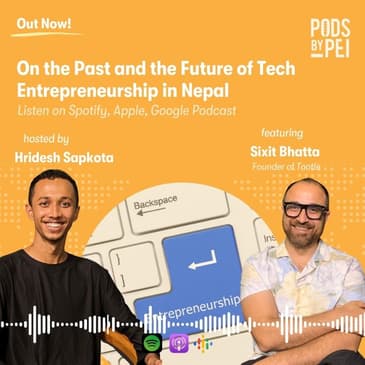
In today’s episode, we have PEI's Hridesh Sapkota in conversation with Sixit Bhatta on Empowering Nepal’s Tech Revolution.
Sixit Bhatta, the founder behind the ride-sharing platform "Tootle," established in 2017, shares his personal odyssey, recounting the challenges he confronted while navigating Nepal's nascent tech landscape. Bhatta paints a compelling vision for Nepal's tech future. He passionately advocates for a transformation from a service export-oriented industry to a research-driven one, poised to fuel groundbreaking technological innovations over the long term. Now more than ever with the rise of technologies like AI, he emphasizes that Nepal must embrace a long-term vision of becoming a research-based tech innovation hub. He underscores that Nepal has laid the foundation for tech innovation but needs to take the next step by focusing on integrated platforms in sectors like unified payment gateways, fostering robust funding avenues for startups, and addressing policy bottlenecks.
If you liked the episode, hear more from us through our free newsletter services, PEI Substack: Of Policies and Politics, and click here to support us on Patreon!!
[00:00:12] - [Speaker 0]
Namaste and welcome to Pods by PEI, a policy discussion series brought to you by Policy Entrepreneurs Inc. My name is Sonia Jimmy. In today's episode, we have PEI colleague, Rilesh in conversation with Sikhshid Bharta on empowering Nepal's tech revolution. Sikhshid is the founder of Tutto, the first ride sharing company in Nepal. A pioneer in sharing and gig economy, Sikhshid is a prominent Nepali tech entrepreneur.
[00:00:40] - [Speaker 0]
He's also an occasional writer at the Kathmandu Post. Ritesh and Sikh Shiv delve deep into the dynamic landscape of Nepal's thriving IT export industry, which has become a crucial contributor to the nation's foreign reserves and GDP. They discuss the rise of technologies like AI and how it's an opportunity for Nepali tech entrepreneurs to focus on research based tech innovations that will ultimately put Nepal on the chart to become a tech hub. Sikhsit underscores that Nepal has laid the foundation for tech innovation but needs to take the next step by focusing on integrated platforms in sectors like unified payment gateways, fostering robust funding avenues for startups, and addressing policy bottlenecks. We hope you enjoy the conversation.
[00:01:35] - [Speaker 1]
Hello, Saksid. Hi. Welcome to PodsRite AI. I'm really excited to have this conversation with you. So let's just start by introducing yourself, and tell me a little bit about your journey in the Nepali tech industry.
[00:01:51] - [Speaker 2]
Thank you very much for inviting to begin with. I'm I'm really excited to speak about things that, you know, we're going to talk about in this in this podcast. And, you know, my name is Sikhsirth, and I happened to found this company called Tuttle, which is the first ride sharing platform in Nepal, which was able to revolutionize the the mobility sector.
[00:02:16] - [Speaker 1]
So my observation is that what you did in the Nepali tech industry in very early nascent stage, I would say, has been an inspiration for other entrepreneurs, and they have followed a certain path that you have created. So talking about Nepali tech landscape, I observe a significant hype going around Nepali tech industry at the current moment, especially after a recent budget announcement where they announced that they are going to incentivize new startups. And if we look at a recent paper that was published by IIDS, the Nipari tech industry was worth almost 500,000,000 US dollars in 02/2022. And with a growth of around 64.2% since the previous year. So as a tech entrepreneur who has been hands on in the field, how do you think Nepali tech industry is doing?
[00:03:24] - [Speaker 1]
Is the hype justified, and what is its performance so far?
[00:03:29] - [Speaker 2]
Well, I think that there are couple of ways of looking into this particular stat. Right? Now we need to go back and unpack the Western business model and compare that to any other industrial business. For example, say a clothing brand. Right?
[00:03:47] - [Speaker 2]
So when you talk about a clothing brand, in most of the occasions, what happens is that the brands are created by the Western economies, but the products are made in in Bangladesh and Vietnam and in countries in the global South because the labor is cheap. So when we look into the statistics and the model that is talked about in this particular case of the tech industry, we are still at a point where the tech industry here thrives on the outsourced technology building process that comes from the West. So most of the research happens in the West. Most of the cutting edge things happen there. But when it comes to building apps or building technologies, which are mostly on the front end side of it, the development works do come here, and that is what has been contributing to this particular growth.
[00:04:46] - [Speaker 2]
But for countries like ours to evolve and to become a powerful tech economies, we should be able to do the kind of cutting edge research and development that has been done in the West. So I see a gap. Right? Because even though we have a growth potential, but we are somehow held hostage by these big companies because they could take those businesses elsewhere also. So that's my assumption of how this business model is evolving or how the tech industry is evolving in Nepal.
[00:05:24] - [Speaker 1]
So there are a lot of challenges, as you rightfully mentioned, but I want to focus right now on the strengths. What are the strengths that Nepali tech industry has that is sort of giving this hope of creating a tech hub? Is it just workers? Is it just the IT force that we have been producing? Or what what is it at play here?
[00:05:52] - [Speaker 1]
I think
[00:05:52] - [Speaker 2]
our workforce is is young Yeah. And our labor cost is also very low. So that can be counted as a strength because the volume of business that comes here because of that is high, because we can be competitive. Right? Earlier on, similar business would go to countries like India, but the labor cost in India has grown.
[00:06:17] - [Speaker 2]
It has become much higher than it used to be in last ten, fifteen years because they are now involved in their own cutting edge technologies. So I think it is because of the comparative economy that Indian labor force or labor force in other competitive countries have gone up, and we are relatively lower, and therefore, the volume of business is coming to to our part. But tomorrow, if we engage in our own research and development as we grow as an industry, the same people who would, say, example, do the masonry work of technology of of putting brick and mortar would then evolve to becoming engineers and building the foundation and the structures of of technology, and therefore, we'll run out of that labor force as well.
[00:07:02] - [Speaker 1]
So for this conversation, Saksed, I would like to broadly categorize opportunities within Nepali tech industry as one those created by foreign forms and the ones that are homemade by tech entrepreneurs. And you are perhaps one of the successful tech entrepreneurs in Nepal. You established Nepal's first ever ride sharing app, Tuttle, in 02/2017. So what was the vision behind and how was your experience starting the Nepali market as a tech entrepreneur?
[00:07:39] - [Speaker 2]
Well, look, when we started with with the ride sharing intervention back in 02/2016, you know, we were very new in terms of understanding how the business model evolves, how the financing has to be done, how we build companies. But there was a very simple goal. The simple goal was that we have lot of people who have challenges when it comes to day to day mobility. But at the same time, we had large number of motorcycles and a spare capacity in those motorcycles that could be used to allow people to make point to point mobility. And the whole idea and the whole vision was that if we were to do that, we would be able to, number one, provide cost effective point to point mobility for people, and at the same time, be able to create jobs for large number of people who otherwise would not have used their motorcycles to make an income.
[00:08:47] - [Speaker 2]
So we're driven by that vision of of creating, number one, jobs, and number two, allowing point to point mobility. And this is very different to the economies that come from the West. So for example, the kind of reference that we have to the Uberization or the company Uber. Right? But Uber exists in an environment, in a country where there are platforms, there there are infrastructures that allow people to move from point a to point b.
[00:09:20] - [Speaker 2]
So if I'm speaking about the home of Uber, say San Francisco, people would have trains, people would have buses to commute, and the taxis wouldn't rip you off. They're transparent. So having Uber as a ride sharing platform in Downtown San San Francisco or Downtown New York only adds to the convenience of a user. It's yet another convenience. And at the same time, we're talking about economies in the West where the unemployment rate is very low.
[00:09:51] - [Speaker 2]
So people are already employed in most of the cases. They don't have to suffer like they do in the global South or countries like Nepal. But in our case, total never added to the convenience of mobility. It was very much the necessity for people to move because they didn't have or our cities lacked that kind of transportation infrastructure. Right?
[00:10:18] - [Speaker 2]
On the other side, if we talk about jobs in our market, a large number of people do not have jobs. So it is not a luxury to have a gig economy where you could contribute as a part time job, but it was about creating a whole new economy where many people could participate. So we are basically driven by these two visions of creating jobs and to also allow people with that point to point mobility.
[00:10:46] - [Speaker 1]
Indeed, the the concept of implementing two wheeler that we abundantly had previously but never thought of using them as a steering transportation means was, in fact, revolutionary. I personally use it every day to commute from my home to office. And if it weren't here, then I probably wouldn't have ever imagined this something that's possible as well because it has created a new avenue. And my observation is that it has also sort of nurtured and germinated these other gig economy opportunities, for example, delivery services and food delivery platforms as well.
[00:11:36] - [Speaker 2]
Well, when we began our our journey, right, we were never inspired by the idea that this is going to become a big company and would have a huge valuation. We were driven by the element of change that we could bring in the society, and it was it was challenging. So the the first thing that we faced was when we began our journey, we needed to have motorcycles or motorcyclists because till the time you didn't have anyone who could drop someone off at the back of their bikes, you know, the business model would not sustain. Right? And we thought that if this is a money making opportunity, many people would come and jump into it.
[00:12:20] - [Speaker 2]
But to our surprise, that didn't happen. Because what we found out was that people here didn't have the dignity in work. So we never wanted to be seen as giving a right to someone and making an income. Look. Let's be honest.
[00:12:34] - [Speaker 2]
Like, no one grows up to become a taxi driver and let alone being a bike taxi driver. Right? But the challenge was again compounded because we had to rely on technology. And when we had to rely on tech, we had to go to people who were tech savvy, who could at least use smartphones and three g. And back in those days, not many people used smartphones, and not many people used three g or four g.
[00:13:01] - [Speaker 2]
So we had to go to these young people who could be early adopters. But people who would have smartphones would already be a little more affluent. Right? And it was a big challenge for them to bring them in into that network because they didn't see it as something that offered them dignity. So that's the first challenge.
[00:13:23] - [Speaker 2]
Then the second was, right, we started at a time when no one used four g. I mean, people didn't actually use because of the perceived cost. Right? And people didn't use payment platforms like eSeeva and and PhonePe, etcetera. PhonePe, I don't think was there back in those days.
[00:13:39] - [Speaker 2]
So we had to not only create an app that did allow people to give rights to people, but we also had to educate them on using a four g or a three g network outside of a Wi Fi zone. We also had to educate them of using these payment platforms. And I don't know if there is a research, but I I surely think pre 2017 and post 2017, I think the uptake of mobile data services and digital payment services would have skyrocketed. Mhmm. And I would like to believe that a large role for that was played by by TURU, by our company.
[00:14:22] - [Speaker 2]
Right? So that was one side of the problem. The other side of the problem was, again, if you were a user to begin with, you would perceive a lot of risk on taking a ride on a motorcycle. How do you trust a person who is not known even though the perception was was a bias? Right?
[00:14:39] - [Speaker 2]
Because I had gone on to explain this to many people on different conversations that I had was while you're taking a taxi, you're still with an unknown person. Right? But when it came to our services, we at least had a tracking mechanism. We had the details of the driver and the passenger. So it was a perceived threat that people had when it came to riding with an unknown person, even though that perception was not justified.
[00:15:09] - [Speaker 2]
So we had to navigate through these kind of challenges.
[00:15:12] - [Speaker 1]
Yeah. And now I would like to move to another landscape of creating these businesses in a country where you have to move through not just the technicalities of things, but also the policy landscapes and other support structures of the state or, I could say, the lack of support structure. So, like, how easy or how difficult I I I assume it was difficult. It is for entrepreneurs to launch such tech startups in Nepal. And are there some essential components, you know, in terms of funding and infrastructure or any other thing that that are missing?
[00:16:01] - [Speaker 2]
I think, you know, we need to really go back and unpack these things. So I would like to tackle this into two headings. One is the financial part of it, and the second would be the the ecosystem part of it. Right? The government support that could necessitate the growth of startup ecosystem in a country like ours.
[00:16:29] - [Speaker 2]
Now look, for us, when we began Tutor, we knew that we were hitting a gray zone. Number one, in a country like Nepal or for that matter, anywhere else, launching a startup in itself is a huge challenge when the rate of failures are very high. But in our particular case, we were dealing with the sector which was already unionized and the government policies were against against this particular intervention. So I think from that perspective, it was it was very, challenging. And we encountered problems like our our drivers being nabbed by police, then a lawsuit being filed by the taxi unions, and inadequate government policies that didn't allow us to thrive the way we would be.
[00:17:24] - [Speaker 2]
But we always had in our mind that even though the policies were not favorable, we were solving a major problem in the society. We were providing jobs to people, and we were providing mobility to large number of people. And therefore, we are very confident that despite the challenges at the stage we were in, we would be able to navigate that through. But on the other side, a business like this also requires a large amount of funding. And in in Nepal, we do not have the level of financial architecture that is required to allow these startups to thrive.
[00:18:04] - [Speaker 2]
We don't have a risk capital. Right? When there's a idea, there would be friends and family who could support in your endeavor, and then there would be people who would pledge that money. But a startup is an environment that requires a very high amount of growth. And at the same time, when you are growing, when you've created a market, there's also a threat.
[00:18:27] - [Speaker 2]
You know, open economy like ours where there would become competitors who would be armed by millions of dollars of funds who could enter that market. So there is no doubt a seed capital in our market that could take the startup off the ground. But to a large extent, there's a lack of risk capital that could fund your startup to achieve a long term goal. So we don't have that risk capital. And unfortunately, the entrepreneurs here, we try to imitate the financial success of the western startups.
[00:19:12] - [Speaker 2]
Say, for example, Silicon Valley. But we also need to understand how Silicon Valley has been able to create these groundbreaking products. So it stems from the fact that, number one, if you talk about Silicon Valley, you have institutes, you have educational institutes, and you have venture capitalist firms there. So you have the talent and the money at the same place. But in our ecosystem, I think we have the scarcity of both.
[00:19:40] - [Speaker 2]
Right? We have not been able to build cutting edge educational institutes, and neither we have been able to build institutes that can fund these ideas. And that, I think, is not a product of of the kind of curriculum that we have or the courses that we offer. I think it's it's about a mindset. Right?
[00:20:02] - [Speaker 2]
Where we have that desire and that curiosity that we can make anything happen. So I think a lot of it, number one, has to do with the mindset of entrepreneurs, and that goes back to our education and our culture where we do not inspire them to achieve these bigger goals, while the same person, if he or she goes to MIT, would be able to achieve those goals. And we do not have a financial infrastructure that can support that that vision and that dream. So these are, I think, from a bird's eye perspective, the kind of challenges that we face here.
[00:20:41] - [Speaker 1]
You have tossed upon a lot of these challenges, and that that's a very broad view. So I'm curious, like, when you were starting out in 2017, the challenges you had faced then, how would you see those challenges right now if there have been any changes in the tech landscape? Either it'd be convincing the state or the policy level changes or the financial side?
[00:21:10] - [Speaker 2]
I think what has happened with with our own intervention is because it gathered a lot of media attention, both for the good things that we did and the failures that we had. I think it serves as a great educational platform for both the entrepreneurs and the government and the policymakers to understand why we had to face what we had to face. And therefore, the policy interventions that could come up could largely be driven by the understanding of what we had to face. But at the same time, I think there's a lot more that the government needs to do. For example, we just had the ecommerce bill, and there's so many clauses, and there have been a lot of debate around the ecommerce bill and the policy around ecommerce and startups.
[00:22:02] - [Speaker 2]
You know, I think the government needs to play an active role as a partner. Right? So for example, if you are ordering a product in Amazon in US, what you have is you go to the app, then you order a product. You would have made the payment through your credit card, and the product would be dropped at your house. So you do not necessarily have to be there to collect the product or make the payment.
[00:22:31] - [Speaker 2]
But in our case, even though we say that, okay, we have to have the growth of ecommerce and startups, we're still confined by the tyranny of space and time, which means that you have to be there to collect the product and you have to be there to make the payment. Now if the government can play an active role in creating the addressing mechanisms of different households. Government could reinvigorate the old post office. You know, thirty years ago when we didn't have emails, we could still send letters by post and it would reach your hand. Right?
[00:23:16] - [Speaker 2]
But today, that network has been shut down. So if the government can play an active role on which if earlier on, if we could send letters by post and reach you at your doorsteps, we could still use that to to send products, and and ecommerce growth could happen because of that. Right? And and payment, of course, facilitate the payment with an integrated platform. So I think there's a lot more role that the government needs to play, not just as an policymaker, but they need to drive activities.
[00:23:51] - [Speaker 2]
Right? Because if you look at the Western models of tech infrastructure, the large part of the thriving infrastructure is already existing. Yeah. So for example, when we talk about the infrastructure and tech, we need to understand look. There's a physical infrastructure.
[00:24:12] - [Speaker 2]
So physical infrastructure is a transportation network, is a road network, is a traffic network, is a logistics network. It's a physical infrastructure. And thirty years ago, on top of that, there was an Internet that was built, and Internet was mostly built as a as a service. It was very expensive. But by 2010, Internet became an infrastructure.
[00:24:38] - [Speaker 2]
So when Internet became an infrastructure on top of that physical infrastructure, then we came up with payments, eServer, PhonePe. So these things were services. But ten years henceforth, these services have now become an infrastructure on top of that. Right? So on top of that infrastructure, we can build services like ecommerce, logistics, ride sharing, and ten years down the line, they would become an infrastructure and tap onto something else.
[00:25:07] - [Speaker 2]
So in in our situation, what we we do have Internet. We do have payment infrastructure. We're building logistics infrastructure on top of that, but the physical infrastructure that leads to the mobility of goods and services, that is lacking. That is lacking, number one, because of the road infrastructure. You know, it takes years for us to build a road.
[00:25:32] - [Speaker 2]
That is lacking because we don't have a proper house addressing mechanism, and that is lacking because of several other reasons. So the government also needs to play a very important role, not only creating this physical infrastructure, but also creating a digital public infrastructure. So when we have that physical infrastructure and a a public infrastructure of of digital network, then it becomes a very strong digital public infrastructure on which startups and innovations can thrive.
[00:26:04] - [Speaker 1]
That's a very interesting observation. So as we mentioned earlier as well, diving into challenges, Nepali educational institutes often come under fire for failing to equip their IT students with in-depth relevant knowledge and training. According to the IITS report I mentioned earlier, also found, and I'm quoting the report, limited skills and competence followed by lack of professionalism are the two major hurdles faced by the IT companies while outsourcing work to Nepali IT worker force. As someone who's currently pursuing a bachelor's degree in computer science in Nepal, I am also anxious about how my course is too focused on traditional theories rather than keeping up with the latest development in the sector, especially for the industry like tech, which is moving very fast. Sixtith, you too are a product of Nepali IT education.
[00:27:08] - [Speaker 1]
So what are your observations? Do Nepal's education and skill development initiatives align with global industry requirements and standards?
[00:27:18] - [Speaker 2]
I think in terms of skills, right, I don't like to believe that we lack skills. And even if we do, I think it's it's easy to train people for skills. But what I have realized in my own journey and looking at the ecosystem is that we have a sense of illusion of understanding. Right? So for example, illusion of understanding is nothing but, like, if I were to ask in a room full of, you know, say 10 engineers who are doing, for example, aeronautics.
[00:27:54] - [Speaker 2]
You know, how many of you know how the airplane flies? I think eight out of 10 would raise their hand and say, okay. I know how the airplane flies. And then I ask you, okay. Out of 10, rate yourself as to how much you think you know how the airplane flies.
[00:28:12] - [Speaker 2]
Then they would rate, say, example, eight. Could be an average rating. Then to the same group of people, then if I were to ask them, okay, tell me about the four forces of flight. I think many of them would not be able to answer. And then if I were to ask them, okay.
[00:28:30] - [Speaker 2]
What's your rating of how much you think you know how the airplane flies? The rating would be, say, six out of 10. And then I go on asking them complex questions of the flight and how the plane flies. Their their ratings would decrease. And then finally, I would give them a document of this is exactly how the airplane flies.
[00:28:51] - [Speaker 2]
Now read it, and then rate yourself as to how much you knew how the airplane flies, then their initial rating will go down. So there's a gap between how much they think that they knew how the plane flies and how actually the plane flies. Right? So in our case, even when I started, I thought it was very easy to create an app, then everyone would use it. And then all of a sudden, you know, they'll have a lot of revenue.
[00:29:19] - [Speaker 2]
So it's not about skills. It's I think it's about illusion. And immediately, when we started Toodle, like I told you at the beginning of this podcast, that we found a challenge that people didn't want to give rights to someone else, which was not expected. Right? And then we had multiple challenges, and we had to navigate through those.
[00:29:39] - [Speaker 2]
So even here, I think if we talk about entrepreneurs, they have this great idea, but that idea also has a lot of illusion. Right? Just like them knowing how the plane flies without actually knowing the details. So the challenge with higher education is that we need to educate them that there has to be a deeper sense of curiosity. And it's not just about solving a problem, it's about uncovering that illusion.
[00:30:11] - [Speaker 2]
And that's where research comes in. Right? That's where research and development comes in when you delve deeper into the problem. So in your question, to to answer your question, it's not just about the skills. It's about the deeper desire and the understanding and the curiosity to solve deeper problems.
[00:30:28] - [Speaker 2]
Mhmm. At the end of the day, if you talk about technology, right, or startup, it's it's easy to create a burger like McDonald's. It's not rocket science. Right? And McDonald's burgers are not that great either.
[00:30:41] - [Speaker 2]
So everybody can make a burger like McDonald's. But to cook a burger like McDonald's and to create McDonald's are two different things. Right? Because creating McDonald is about that operation, that that shoes, bells and whistles, investment, and everything, and there's a large gap. So I think our education system gives them a very superficial view of skills, and these skills are enough to take you forward, but does not give us that critical thinking Mhmm.
[00:31:13] - [Speaker 2]
That creative abilities by which we could uncover the depths of of those nuances that we need to look into. So I think that's the that's the challenge. And and that that also has that also has a has had a repercussion in our own ecosystem. I'll tell you how. So for example, if you look at the app, everyone feels technology is like building an app.
[00:31:37] - [Speaker 2]
So if you open your phone, there could be a Twitter app, and there could be some other app, say a local app. They occupy the same real state in your app, and everyone feels that, okay, Twitter app and the other app is almost the same, and it should be easy to create that app. But there's a huge difference between the amount of data and transaction that Twitter app produces every millisecond compared to, say, some QFX app in Nepal. Right? So it's not with the app that's built on the phone.
[00:32:10] - [Speaker 2]
It's about the deeper engineering and the architecture where the meat is. So if you'll if if you were to use that narrative, app is just the facade of the building, which is seen, and our skill sets are mostly designed towards creating that app. But creating a technology is not just the app. It's about the architecture of the building, where you need architects to design how many stories it can go up. Then you would have engineers who would design how the rooms would be made and how the spaces could be utilized properly.
[00:32:44] - [Speaker 2]
So it requires an entire architecture and and engineering that can that can allow that particular platform to have large number of users at the same time. But unfortunately, here, you know, we think that our app solves the problem, and therefore, we have to value this app. So it's it's just like a real estate developer building a mock house. Right? Then you go in there, and the developer shows you how many bedrooms you have and and the living room, and this is how it looks.
[00:33:18] - [Speaker 2]
But that building does not have a structure or a it does not have solid foundation. It's just a mock house. And what you do is by looking at the mock house, then they would sign a contract and take an advance from you and do a MOU. And then when when these real estate developers have the MOU with, say, a 100 number of customers or thousand number of customers, then they go to the financiers, the banks or the venture capitalists, and they said, okay, I already have these many customers. Now you should loan me money to build this project.
[00:33:50] - [Speaker 2]
So I've seen in in Nepal, our our tech industry is going through this financial engineering. It's not a technical engineering. It's a financial engineering. So what they do is they have an app that can solve a problem. It can do, say, example, if it's a ride sharing, it can do, say, 50 rides a day, but not 5,000 it cannot do 5,000 rides a day.
[00:34:10] - [Speaker 2]
And based on that, there is that valuation. But you don't have the structure that's required to scale. Right? Because that requires a lot of research, lot of uncovering of that illusion of knowledge that we spoke about. So we are into this wild goose chase, I would say.
[00:34:29] - [Speaker 1]
Yeah. So my observation is that the education system we have that provides a very shallow knowledge or just surface level understanding that is resulting in us not focusing on these deeper issues, just giving this illusion that just creating an app is creating a tech revolution. Now we come to another very hyped about topic that is AI. And since a couple of months or a year now, it has become topic of discussion everywhere, be it newspaper, be it creating these service platforms. You see every other platform running around to implement these so called, quote unquote, magic technologies.
[00:35:19] - [Speaker 1]
Now I want to come to the implications of rise of these technologies like AI and how it unfolds in countries like Nepal and what impacts does it have. With recent advancement in technologies like AI, how do you anticipate these developments shaping Nepal's tech industry?
[00:35:43] - [Speaker 2]
But before that, I think we need to unpack the AI and the kind of godlike technologies Mhmm. That people perceive. There was a quote that you were talking about. Can you share that quote?
[00:35:55] - [Speaker 1]
Yeah. Sure. So it's from a famous sociobiologist. I exactly forgot the name, but so we have paleolithic emotions Mhmm. Medieval institutions, and godlike technology.
[00:36:09] - [Speaker 1]
Mhmm.
[00:36:11] - [Speaker 2]
Yeah. So, yeah, that's that's a very interesting quote. Yeah. So I'd like to begin from from the brain part because, you know, cognitive psychology is one of the topics that I like to like to read. So it it says that our brain is is very old, and then our institutions are medieval, and the technology is godlike.
[00:36:29] - [Speaker 2]
Look. If you look at human beings from the very beginning of our evolution, what has happened is that we started using our hands unlike any other animal. So when we started using hands and our limbs to stand upright and walk and then do small small things with with our fingers, no other animals can can use their fingers like we human beings do. We started to discover fire, and then we started to have cooked food. So what that did was it removed a lot of effort from our mouth.
[00:37:07] - [Speaker 2]
So for example, if you look at any other animal, a large amount of effort in feeding themselves goes to their mouth. But for us human beings, we freed up the mouth and we started developing speech. We started having cooked food. So what that did was a large part of our digestion already started to happen because we started to have cooked food. So the energy that was required to digest food went on to developing our brain and speech.
[00:37:40] - [Speaker 2]
So our gut started becoming smaller, and a large part of that energy went onto our brain. So brain consumes a lion's share of the energy that we humans consume every day. So our brain is not just paleolithic. It has evolved over the years as we do things, tasks that require more cognitive skills. And as we went on to discovering agriculture ten thousand years ago, human beings started to have sedentary life.
[00:38:12] - [Speaker 2]
So there was less amount of physical energy that was required, and more amount of that part of that energy went on to again, go on to our brains to focus on innovation, do things, and and create tools, technologies. So in that process, over thousands of years, human quest was either to find a newer source of energy or to become more efficient with the given source of energy. So if we use hands, then we started using draft animals. So that was a different source of energy. Right?
[00:38:49] - [Speaker 2]
Then we started using harnesses to improve energy. Till industrial revolution, when we came up with internal combustion engine, it was the very first time that human beings outsource the source of energy to internal combustion engine. What that did was it was a newer source of energy, and it was more efficient. And when we say efficient, what had happened was, number one, the machines that we built would do tasks much faster and consume less energy. But over the last twenty years in in the information age, what has happened is with the collection of data and with computing, that efficiency has gone up by a large margin.
[00:39:32] - [Speaker 2]
And what has contributed to that is the growth of companies in Silicon Valley. Right? Because in late nineteen nineties, everyone invested in companies in Silicon Valley. Because at that time, they were creating a large number of data, and the valuation of these tech companies went very, very high. Now why that happened was it was a departure from an industrial economy to the information economy.
[00:40:01] - [Speaker 2]
So when you talk about, say, industrial economy, so for example, if you had a jar with some water in it and you would ask the investor to invest in that company, say the company is a jar with water, they would know what water is. They would roughly know how much water is in the jar, and then they would value that jar as to how much water can fill in that jar. And they would make an investment based on that calculated value of the company. But in the late nineties, what happened was as we started producing data, the Silicon Valley entrepreneurs said, look, we have a jar full of data. Now invest in it.
[00:40:39] - [Speaker 2]
But the investors never knew how to value that data. But the entrepreneurs came up with the idea that in twenty years' time, ten years, five years' time, we would be able to use that data. So it was because of the lack of understanding of what that data would do, they started pouring in money. And and with Google, it started the surveillance economy because they had the data, and there was a dot com crash in 1990. And even though Google was founded with a very noble cause of organizing information from across the world, because there was a dot com crash and because they had to find revenues, they collected your data and sold that data to the advertisers to make revenue.
[00:41:19] - [Speaker 2]
And that was the attention economy where where your attention was the commodity because everything that you typed on Google or, for that matter, Facebook, was the data of your attention that was captured and then sold to advertisers for a higher value. Right? So that was the monetization of tech industries. And when that attention economy now is at its peak and probably does plateaued out, we have a new thing that's come up with all that data that has been gathered in last twenty years, and that's the AI. And right now, we've seen that every Tom, Dick, and Harry is coming up with AI products.
[00:41:59] - [Speaker 2]
Because just like the late nineties, where everyone was into that .com bandwagon, where everyone had the data and wanted venture capitalists to invest in their companies just by being able to collect data. Twenty years henceforth, we are at a place where AI people don't understand what it is, just like people didn't understand what data would do in last twenty years. Today, most of the people don't understand what would happen to AI in the next ten, twenty years. But everyone is flocking into that, not because they understand it, but because of the lack of understanding and because there have been stories that have been told that with AI, we'll be able to achieve so on and so forth. And we only need to look into, say, next ten years as to where it will go.
[00:42:45] - [Speaker 2]
So that is where we are at. Right? And the first thing that is already doing is it's it's it's replacing human cognitive skills. Right? Throughout the history till till before AI came up with, our human biology evolved in a way that we offered less physical task through industrial revolution, because less physical task meant that we could use our brain in in doing cognitive tasks and so on and so forth.
[00:43:16] - [Speaker 2]
But what has happened right now is that your cognitive tasks have now been replaced by machines, by AI. So we do not know as to what will happen, but immediately what's going to happen is things like the impact of AI on tech industry would would be huge because earlier on, it would be the programmers who would write software. Now it'll be the data that'll write the software. So things like building the app, building the websites, and things that were the jobs that were outsourced to countries like Nepal will be done by AI. So the economic figures that you spoke about at the beginning of our conversation, you know, with AI, those things would be done by AI itself.
[00:43:59] - [Speaker 2]
And therefore, it will have a repercussions in in in our tech industry until until there's a huge skill upgrade that we can have. So for example, when the industrial revolution happened in eighteen hundreds, right, we moved from, say, plowing the field to driving a tractor. But the skill gap between a farmer plowing a field to plowing with a tractor or driving a tractor wouldn't be that big of a gap. Right? But today because the physical skills were replaced by machines.
[00:44:34] - [Speaker 2]
But when the cognitive skills of of a developer is now replaced by AI, which is going to write the codes and then create an app on the phone or create a website for the for the company or for anyone else, there is a huge jump in skill that we need to have. So so that's going to be a challenge, and it will again reflect back to our education system and things like critical thinking, creativity as to how we want to produce our resources.
[00:45:03] - [Speaker 1]
Mhmm. Yeah. Definitely. So that was very insightful indeed. And with the rise of technologies like AI, maybe it's time for us to rethink what it means.
[00:45:19] - [Speaker 2]
Yeah. I think it it it will also create a huge societal divide. Because, look, when we came into the attention economy and and data, the data would always be biased, and the algorithms would have always been biased. So, for example, when we started Toodle, we had to make sure that our drivers took a large number of rides. So what we used to do was we would say that if you take 10 rides, then we'd give you, say, 500 extra for completing that particular number of rides.
[00:45:53] - [Speaker 2]
But what we did was after the nine rides were completed, the tenth ride would not naturally go to that person because that would be a loss to me, loss to the company. So we could enhance. We didn't do that. Yeah. But we could we could literally Yeah.
[00:46:05] - [Speaker 2]
Create a bias in the algorithm by which you could go on taking nine rides, so the job of the company is fulfilled. And then then you would starve for the tenth ride because it would not be profitable for the company. Right? So when we think about algorithm, I often like to compare it to, say, a recipe. So when my mom cooks, say, it's some meat item.
[00:46:30] - [Speaker 2]
Right? So she had chicken, she has then some spices and some onions by the side, and she cooks that food and gives it to me. Now if those ingredients are are data and the final product is the algorithm, the outcome that she wants from that food is the health and the happiness of her children. That's the bias she has. But when you try to eat a similar recipe in a restaurant, the chef in a restaurant would also use the same ingredients.
[00:47:09] - [Speaker 2]
But for a chef and the owner of the restaurant, the outcome that he or she wants is the profitability for the restaurant. And because of that, they could cut corners on on hygiene and the quality of onions that they would get and the quality of meat they would buy. Right? So there's a bias. Even though you use the same data, even you use the same ingredients, it could be fed with that bias.
[00:47:33] - [Speaker 2]
So from the very beginning of the tech industry of of the information economy, companies like Google have always been biased because for them, the way they've arranged data was not like our parents, our mom, who would cook food. The way they would have arranged data is more like a chef in a restaurant. So which means that if you use a Google Map to go from point a to point b, they could literally show you a route that could display more advertisement if the advertisement was shown by Google than to give you a shortest route, and we'd have to take that route because we trust Google more than we trust our instincts today. That's how we've been trained. Now today's AI also thrives on on the level of data that we've compiled for last twenty years, and every bit of data that has been compiled for last twenty years has been fed with that bias.
[00:48:26] - [Speaker 2]
So what will happen tomorrow is that we're going to have that algorithmic divide. We're not going to have a digital divide. We're going to have a algorithmic divide because the AI algorithms in themselves would be hugely biased because those biases have been fed for over last twenty, thirty years. And algorithmic biases are more dangerous than the digital divide. So for last twenty years, we used to speak about a digital divide, and it's easier to measure that there's a digital divide between you and me based on do you have a Internet connection or not, what kind of smartphone you use, do you have a computer in your house or not.
[00:49:05] - [Speaker 2]
But when you're talking about an algorithmic divide, algorithms are totally opaque. If a chef were to cook a food, he or she would present in a nice plate in a five star restaurant or in a Michelin class restaurant, but you'd not know the intention behind, the biases that have been behind that particular food. Yes. Definitely. So so these are the challenges that I think we'll face.
[00:49:28] - [Speaker 1]
Yeah. Definitely. And it's so these are challenges that we obviously have with these technologies, but along with challenges, there are also opportunities. So how could a Nepali tech entrepreneur or someone in countries like Nepal could use technologies like AI in their benefit and implement it into their services or products?
[00:49:56] - [Speaker 2]
You know, I think let's let's leave AI for a bit. Look, we need to think about our own philosophies and and our own economies as to how they function. And the whole notion behind when we started Tutor was based on on not adding convenience to mobility like the West, but creating jobs and efficiency in in our own system. So if you look at the Western models and the way they would want to use artificial intelligence is based on on removing the labor force, because for them, labor is very expensive. So if you talk about Uber, Uber wants to have a self driving car because the large part of what you earn as a revenue goes to the driver.
[00:50:42] - [Speaker 2]
But think about our economies. Our economies won't sustain if we have that model because there would be a large number of useless people. Mhmm. In industrial revolution, we used to have people who were exploited. Mhmm.
[00:50:53] - [Speaker 2]
And if we were to go the same route, we would have a large number of useless people because we would have taken them because of AI from the job market. And I think having useless people is more dangerous than people who are exploited. So the way we should look into these technologies is to add efficiencies in our ecosystem. So for example, if we have a value chain, we need to make sure that we implement technologies by which that value chain, the player in the value chain becomes more efficient. Think about things like, say, agriculture.
[00:51:33] - [Speaker 2]
Now the the only reason that we have so much challenge with the agro market is that there's a disparity in information between the point of production and the point of sale, and the value chain actors have not been supplied with the right amount of technologies, maybe accounting, stock keeping, or delivery or things like that. Now if you can automate those functions, and and these people would not want to adopt technologies just like the taxi driver didn't want to adopt TOOTO to begin with. So what we need to do is we should be able to implement these kind of technologies in these sectors where we do not remove the value chain actors, but we add efficiency to them. Say, for example, ecommerce as it is thrives in the Western market, say US, because of the sociocultural living. So there's a downtown, and they they live at the far flung areas.
[00:52:30] - [Speaker 2]
They shop once a week, drive fifteen, twenty minutes to the department store, stock up things for a week, things like that. But here, we have mom and pop stores everywhere. Now if we were to implement ecommerce exactly the way Amazon is doing it in the West, we would be removing that mom and pop store right out of our doorsteps, and we'd be eating up to the economy. Right? But we could empower these stores with technology.
[00:52:59] - [Speaker 2]
So when you open an app, so instead of showing what you buy in Amazon or Daraj, you could have because we have all that location information, you could say, okay, store near you has whatever you want right in front of you. And that technology could go on to improve their efficiency. And because of that, they would know these the stores would know what are the products that are required by my neighborhood. Then they could stock those things up and and then add payments to it, add accounting to it. So what will happen is the value chain actors would be efficient.
[00:53:33] - [Speaker 2]
And if you could add 10% of efficiency on each value chain actors, the overall implication to the economy would be huge. So we need to look at AI not in terms of removing the workforce from the system, but to empower the value chain actor.
[00:53:49] - [Speaker 1]
Now, Saksit, coming back to the policy front. Mhmm. In your view, what policy level adjustments are indispensable to nurture the tech industry's growth in Nepal? And also, are there opportunities for governmental and private entities to collaborate, to cultivate an environment conducive to innovation and entrepreneurship?
[00:54:12] - [Speaker 2]
Yeah. I think the government needs to play more of an active role because we're talking about a young industry, unlike it playing a role in industries like trading and other industries where things and SOPs for those industries have already been established. This is an area where the government needs to have a much larger role to play, and I think we can draw some parallels from from India. So what has happened in India for the last ten years is that there are around more than 700,000,000 people that have had access to Internet. And because of which, these people have been added to economy on different fronts, like e commerce to payments and other things.
[00:55:00] - [Speaker 2]
But it has not just happened out of the blue. I think India as a country has played a very interesting role in creating that digital public infrastructure so that it reaches to all of them. So for example, they've created something called UPI, the payment platform. Right? And they're connecting UPI to countries like Singapore and Middle East where people can make instant transactions.
[00:55:29] - [Speaker 2]
So I think even in Nepal because look. We're not US where these infrastructures are owned by the private company already, and neither like we are China where the government owns the entire system. So I think and and and these kind of infrastructure is is largely absent. So number one, government needs to play an active role in creating that digital public infrastructure, and the foundation of which would be the physical infrastructure of, say, optical fiber or or the communication links that reaches to all parts of the country. And then create a common platform of, say, payment on which anyone can tap into.
[00:56:12] - [Speaker 2]
So I'll just give you an example. So in Nepal, you have the the passport, then we have the NID, national ID, and then you go to bank account. Right? So if I have a national ID, by just clicking on that number, the bank should be able to open an account immediately. But here, people don't have access to finance because the banks cannot tap into that government infrastructure.
[00:56:40] - [Speaker 2]
So technically, what should have happened was if you have the national ID, that database should be accessible by telecom operators, financial institutions, and you could go to every village, and within five minutes, your account should be opened. But that's not happening, isn't it? So we have the foundational things. We have the pillars of those econ. So when we talk about national ID, we have that pillar.
[00:57:04] - [Speaker 2]
When you talk about the driving license, we have that pillar. We have the passport pillar. But we don't have a foundation that connects all of them. So I think the government needs to create that foundational digital public infrastructure. The way they did it in India was they had this Aadhaar card, and the information would be shared.
[00:57:21] - [Speaker 2]
So today, if you go to India and if you have a traffic ticket, immediately, that ticket would come to your mobile phone, and then you'd make that payment through your mobile app, isn't it? Because everything is connected. So unfortunately, in our case, we have the pillars, and these pillars have been led or or built not with a vision of accomplishing that infrastructure which is integrated, which can solve problems for for general public, have them access to telecommunication, finance, or g two p payments. It had just been built with a motive of tendering or bidding process. So before we get into the policy, I think we need to create that kind of digital infrastructure because when that happens and when the transactions flow through that infrastructure, I think the scope of corruption would also come down.
[00:58:19] - [Speaker 2]
There would be an efficiency in the system, and the government can really use that infrastructure, not only to benefit selected few in the cities, but also the large masses in the rural and the far flung areas where they have equitable access to technology. Because when we talk about technology division, I think technology should not divide between the rich and poor. They should have same access. At least from the government service point of view, they should be equal. And I think building that infrastructure could be the first step into having that policy framework.
[00:58:52] - [Speaker 2]
So it needs to be more hands on rather than just playing a regulatory role. You have to do something. They've started that, I think, you know, twenty years ago when I joined telecom industry. They used to have something called the rural telecom development fund, where 2% of the revenue earned by the telecom operators would go into building the physical infrastructure at least. I don't know where it is, but I think from a policy point of view, we need to keep a close eye on on how that's progressing and how other pillars of database progressing and how these things are being integrated.
[00:59:27] - [Speaker 2]
I I think that'll be a very good beginning.
[00:59:29] - [Speaker 1]
Thank you, Saksit, for having this very insightful conversation, and we have quite a bit of things that we can take away from this conversation. And we hope that these things will be addressed by our upcoming policies and our upcoming tech entrepreneurs.
[00:59:51] - [Speaker 2]
Thank you for having me.
[00:59:56] - [Speaker 0]
Thanks for listening to POTS by PEI. I hope you enjoyed Ritesh's conversation with Sikhshid on empowering Nepal's tech revolution. Today's episode was produced by Neogen Rai with support from Kushihang, Ritesh Sapkota, and me, Sonya Jimmy. The episode was recorded at PEI Studio and was edited by Ridesh Sapkota. Our theme music is courtesy of Rohit Shakya from Jindabad.
[01:00:22] - [Speaker 0]
If you like today's episode, please subscribe to our podcast. Also, please do us a favor by sharing us on social media and leave a review on Spotify, Apple Podcast, Google Podcast, or wherever you listen to the show. For PEI's video related content, please search for policy entrepreneurs on YouTube. To catch the latest from us on Nepal's policy and politics, please follow us on Twitter tweet2pei, that's tweet followed by the number two and PEI, and on Facebook policy entrepreneurs inc. You can also visit pei.center to learn more about us.
[01:01:00] - [Speaker 0]
Thanks once again from me, Sonia. We'll see you soon in our next episode.